
Chapter Two Vocation to be a sister—The Rising Sun
※ Click on the image to view a larger version. PDF File
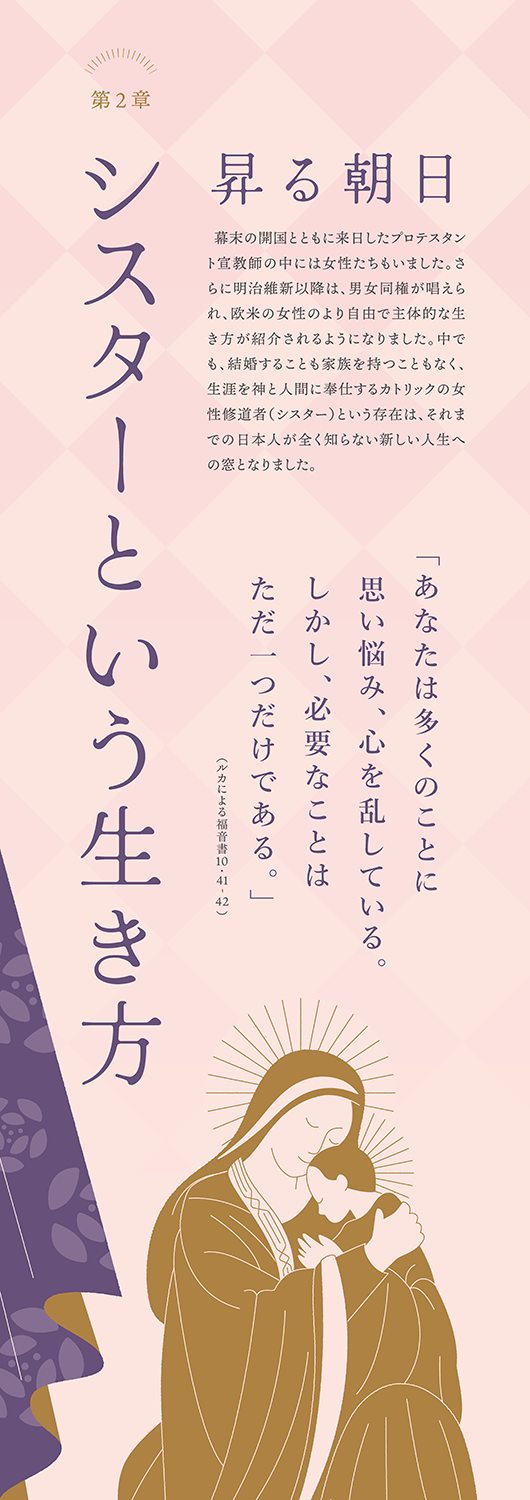
With the opening of Japan at the end of the Edo period, Protestant missionaries who came to Japan included women. Following the Meiji Restoration, the idea of equality between men and women began to be advocated, and more independent and self-directed ways of life for women in Europe and the United States were introduced to Japan.
Among these, the existence of Catholic women religious—sisters who neither married nor formed families but devoted their entire lives to serving God and humanity—opened a window onto an entirely new way of life previously unknown to the Japanese people.
“You are worried and distracted by many things;but there is need of only one thing.” (Gospel of Luke 10:41–42)
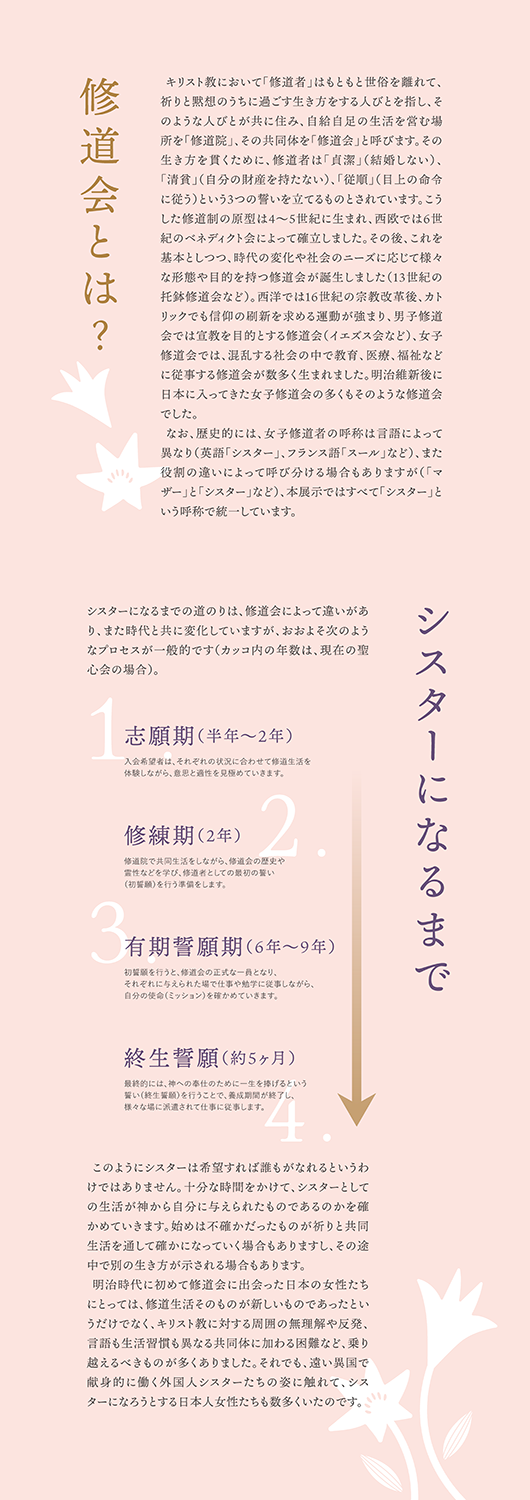
In Christianity, the term "religious" originally refers to people who withdraw from secular life and devote themselves to a way of living centered on prayer and contemplation. The places where such people live together and sustain themselves through a self-sufficient lifestyle are called monasteries, and their communities are known as "Religious orders."
To live out this way of life, religious take three vows: "chastity" (not marrying), "poverty "(owning no personal property), and "obedience" (submitting to the authority of superiors). The prototype of this monastic system emerged in the fourth and fifth centuries, and in Western Europe it was firmly established in the sixth century by the Benedictine Order.
Building on this foundation, a wide variety of religious orders with different forms and purposes came into being in response to changing times and social needs, such as the mendicant orders of the thirteenth century. After the Protestant Reformation in the sixteenth century, movements for spiritual renewal also intensified within Catholicism. Among men’s religious orders, communities dedicated to missionary work—such as the Society of Jesus (Jesuits)—were founded, while among women’s religious orders, many congregations emerged that engaged in education, medical care, and social welfare amid increasingly complex social conditions. Many of the women’s religious orders that arrived in Japan after the Meiji Restoration belonged to this latter type.
Historically, the titles used for women religious have differed by language (such as “sister” in English and “sœur” in French), and in some cases distinctions have been made according to role (for example, “mother” and “sister”). In this exhibition, however, all women religious are referred to uniformly as “sisters.”
The Process of Becoming a Sister
The path to becoming a sister differs among religious orders and has changed over time, but it generally follows the process outlined below (the periods in parentheses reflect the current practice of the Society of the Sacred Heart).
1. Aspirancy (six months to two years)
Applicants experience religious life in ways suited to their individual circumstances while discerning their vocation and suitability.
2. Novitiate (two years)
Living in community at the convent, candidates study the history and spirituality of the order and prepare to make their first religious vows (temporary professions).
3. Temporary Vows (six to nine years)
After making their first vows, candidates become full members of the order. While engaging in work or study at their assigned ministries, they continue to discern their personal mission.
4. Final (Perpetual) Vows (approximately five months)
Through the profession of perpetual vows—committing one’s entire life to the service of God—the formation period is completed, and sisters are then sent to various ministries to carry out their work.
Thus, becoming a sister is not something anyone can do simply by wishing for it. Over time, a woman carefully discerns whether religious life is truly a calling from God. What may at first seem uncertain can become clearer through prayer and life in community, whereas in other cases, a different path in life may be revealed along the way.
For Japanese women who first encountered religious orders in the Meiji period, religious life itself was something entirely new. Additionally, they encountered many obstacles, including misunderstanding and resistance toward Christianity from those around them, as well as the challenges of joining communities with different languages and ways of life. Even so, many Japanese women were inspired by the devoted work of foreign sisters in a distant land and chose to become sisters themselves.
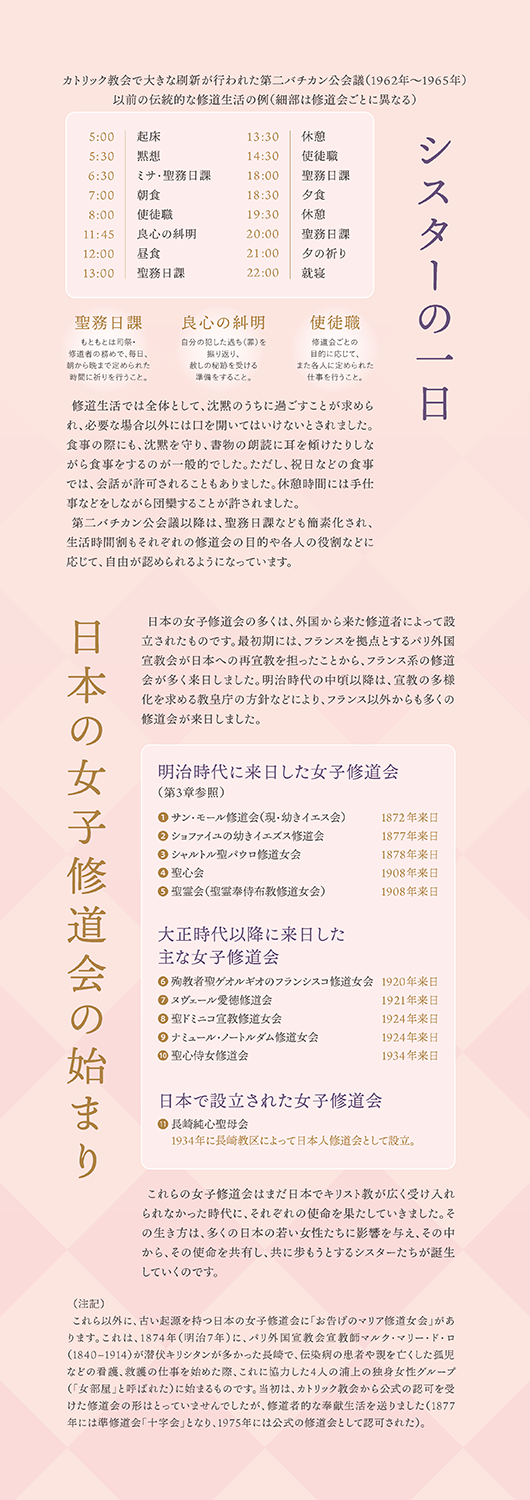
A Day in the Life of a Sister
An example of traditional religious life prior to the Second Vatican Council (1962–1965), which brought major reforms to the Catholic Church(details varied among religious orders).
5:00 Wake-up
5:30 Meditation
6:30 Mass and the Liturgy of the Hours
7:00 Breakfast
8:00 Apostolic work
11:45 Examination of conscience
12:00 Lunch
13:00 Liturgy of the Hours
13:30 Rest
14:30 Apostolic work
18:00 Liturgy of the Hours
18:30 Dinner
19:30 Rest
20:00 Liturgy of the Hours
21:00 Evening prayer
22:00 Bedtime
Liturgy of the Hours: Originally the duty of priests and religious, this refers to praying at fixed times from morning to night each day.
Examination of Conscience: Reflecting on one’s faults (sins) and preparing to receive the Sacrament of Reconciliation.
Apostolic Work: Work carried out according to the mission of each religious order and the role assigned to each individual.
In religious life, silence was generally required as a guiding principle, and speaking was permitted only when necessary. Even during meals, silence was observed, with sisters often listening to readings from books. On feast days, however, conversation was sometimes allowed. During the hours for rest, sisters were permitted to socialize quietly while doing handwork.
After the Second Vatican Council, practices such as the Liturgy of the Hours were simplified, and daily schedules became more flexible, allowing adaptations according to the mission of each religious order and the roles of individual members.
Many women’s religious orders in Japan were founded by religious sisters who came from overseas. In the earliest period, many French religious orders arrived in Japan because the Paris Foreign Missions Society, based in France, took responsibility for re-evangelizing the country. However, from the mid-Meiji period onward, in response to policies of the Holy See that sought to diversify missionary activity, numerous religious orders from countries other than France also came to Japan.
Women’s Religious Orders that Came to Japan during the Meiji Period (see Chapter 3)
- The Sisters of Saint Maur (now Infant Jesus Sisters) – arrived in Japan in 1872
- The Sisters of the Infant Jesus of Chauffailles – arrived in Japan in 1877
- Congregation of the Sisters of St. Paul of Chartres – arrived in Japan in 1878
- Society of the Sacred Heart – arrived in Japan in 1908
- Missionary Sisters Servants of the Holy Spirit (Holy Spirit Missionary Sisters) – arrived in Japan in 1908
Major Women’s Religious Orders that Came to Japan from the Taishō Period Onward
- Congregation of the Sisters of Saint Francis of the Martyr St. George – arrived in Japan in 1920
- Congregation of the Sisters of Charity and Christian Instruction of Nevers – arrived in Japan in 1921
- Missionary Sisters of St. Dominic – arrived in Japan in 1924
- Sisters of Notre Dame de Namur – arrived in Japan in 1924
- Handmaids of the Sacred Heart of Jesus – arrived in Japan in 1934
Women’s Religious Orders Founded in Japan
- Sisters of the Immaculate Heart of Mary of Nagasaki – founded in 1934 as a Japanese religious congregation by the Diocese of Nagasaki
These women’s religious orders carried out their respective missions at a time when Christianity was not yet widely accepted in Japan.
Their way of life had a profound influence on many young Japanese women, and from among them emerged sisters who chose to share that mission and walk the same path together.
(Note)
In addition to these, there is a Japanese congregation of women religious with an even earlier origin, known as the Sisters of the Annunciation of Mary. This congregation traces its beginnings to 1874 (Meiji 7), when the Paris Foreign Missions Society missionary Marc Marie de Rotz (1840–1914) began caring for patients suffering from infectious diseases and for orphans who had lost their parents in Nagasaki, an area with a large population of Hidden Christians (Senpuku Christians). The congregation originated in a group of four unmarried women from Urakami—known as an onna-beya (“women’s house”)—who cooperated in this work.
At first, they did not take the form of a religious institute officially recognized by the Catholic Church, but they lived a consecrated life in a religious spirit. In 1877, they became a quasi-religious institute known as the Jujikai (Society of the Cross), and in 1975 they were officially recognized as a religious congregation.
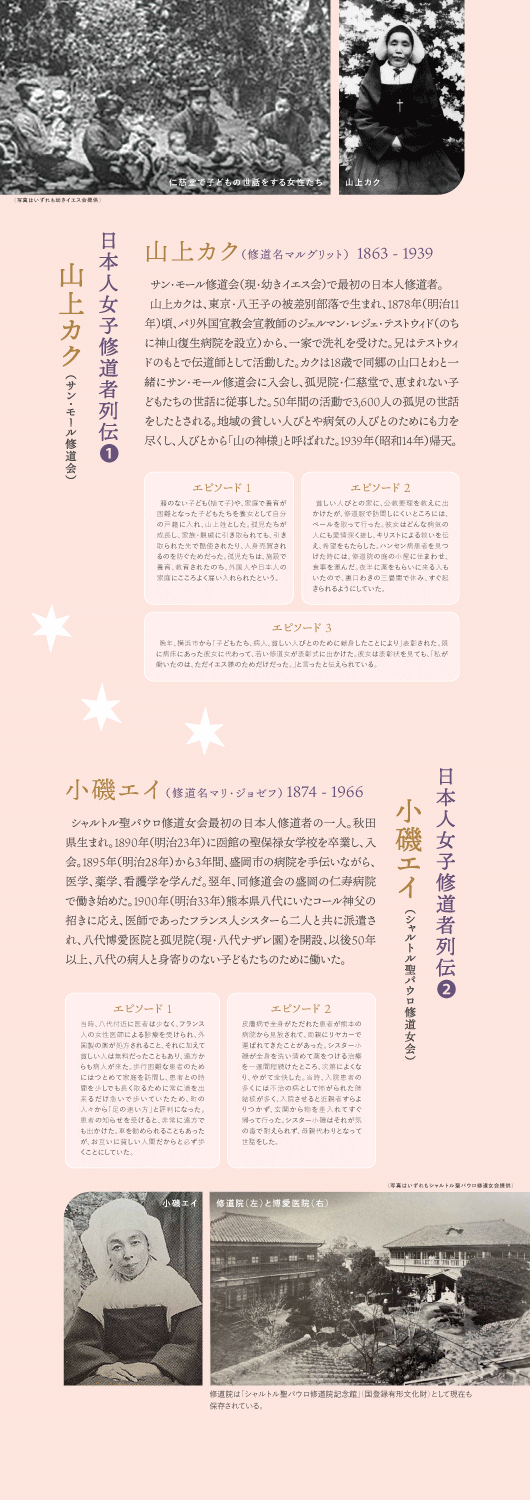
Vol. 1: Kaku Yamagami (Sisters of St. Maur)
Kaku Yamagami (1863–1939) (religious name: Marguerite)
The first Japanese religious sister in the Sisters of St. Maur (currently the Infant Jesus Sisters).
Kaku Yamagami was born in a discriminated community (burakumin) in Hachioji, Tokyo. Around 1878 (Meiji 11), her entire family was baptized by Germain Léger Testevuide, a missionary from the Paris Foreign Missions Society (who later established the Koyama Fukusei Hospital). Her elder brother worked as an evangelist under Testevuide. At the age of 18, Kaku joined the Sisters of St. Maur with Towa Yamaguchi from the same region and engaged in caring for disadvantaged children at the Jinjido orphanage. She is said to have looked after 3,600 orphans during 50 years of activity. She also dedicated her efforts to the poor and sick people in the community and was called "Yama no Kamisama" (Goddess of the Mountain) by the people. She passed away in 1939 (Showa 14).
Episode 1:
Kaku Yamagami took in children without registration (abandoned children) and those whose families had difficulty raising them as adopted daughters, putting them into her own family register with the Yamagami surname. This was to prevent the orphans from being mistreated or trafficked if they were taken in by family or relatives after growing up. The facility educated and cared for the orphans, who subsequently found employment with foreign and Japanese families.
Episode 2:
She went to the homes of poor people to teach catechism, but in places where it was difficult to visit in a habit, she went without her veil. She interacted with sick people of all kinds with deep affection, conveyed salvation through Christ, and brought them hope. When she found a person with Hansen’s disease (leprosy), she let them live in a hut in the convent garden and brought them meals. There were also people who came to get medicine in the middle of the night, so she rested in a three-tatami-mat room beside the back door so she could get up immediately.
Episode 3:
In her later years, she was commended by Yokohama City "for her dedication to children, the sick, and the poor." A young nun attended the awards ceremony on her behalf, as she was already bedridden. It is said that even when she saw the certificate of commendation, she said, "I only worked for Jesus."
Japanese women caring for children at the Jinjido (all photographs courtesy of the Infant Jesus Sisters).
Vol. 2: Ei Koiso (Congregation of the Sisters of St. Paul of Chartres)
Ei Koiso (1874–1966) (religious name: Marie Joseph)
She was one of the first Japanese religious sisters in the Congregation of the Sisters of St. Paul of Chartres. Born in Akita Prefecture, she graduated from St. Paul's Girls' School in Hakodate in 1890 (Meiji 23) and joined the order. From 1895 (Meiji 28) for three years, she studied medicine, pharmacy, and nursing while helping at a hospital in Morioka City. The following year, she began working at the order's Jinju Hospital in Morioka. In 1900 (Meiji 33), she and two other French sisters, including a doctor, were dispatched in response to an invitation from Father Cohl in Yatsushiro, Kumamoto Prefecture. They opened the Yatsushiro Hakuai Hospital and an orphanage (now the Yatsushiro Nazareth Garden) and worked for over 50 years for the sick and orphaned children of Yatsushiro thereafter.
Episode 1:
At that time, there were few doctors in the vicinity of Yatsushiro, and many patients came from afar because they could receive medical treatment from a French female doctor, were prescribed foreign-made medicines, and the poor could receive treatment for free. For patients who had difficulty walking, she made an effort to visit their homes, and because she always hurried along the road as much as possible to spend even a little longer with the patient, she was known among the townspeople as "the one who walks fast." When she was informed about a patient, she would go even if it was very far away. She was sometimes offered a cart, but she always chose to walk, saying that they were all poor people.
Episode 2:
There was a time when a patient with a skin disease, whose entire body was sore, was brought to her by their parents in a cart after being turned away from a hospital in Kumamoto. Sister Koiso continued to wash the entire body clean and apply medicine for about a week, after which the patient gradually got better and eventually fully recovered. At that time, many inpatients had pulmonary tuberculosis, which was feared as an incurable disease. When a person was hospitalized, even close relatives would not come near, but would put things in from the entrance and leave immediately. Sister Koiso found this pitiful and unbearable, and took care of them as if she were their mother.
The convent (left) and the Hakuai Hospital (right). The convent is preserved today as the Congregation of the Sisters of St. Paul of Chartres Memorial Museum (Registered Tangible Cultural Property of Japan).
(All photographs courtesy of the Congregation of the Sisters of St. Paul of Chartres.)
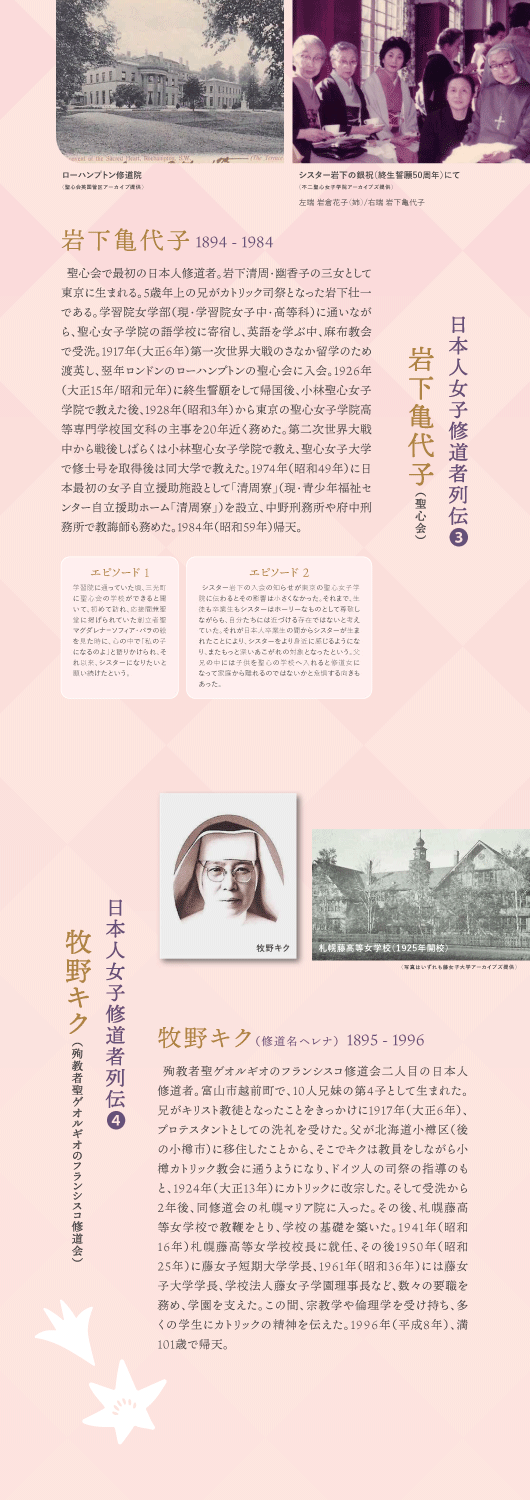
Vol. 3: Kiyoko Iwashita (Society of the Sacred Heart)
Kiyoko Iwashita (1894–1984)
The first Japanese religious sister in the Society of the Sacred Heart. She was born in Tokyo as the third daughter of Kiyochika and Yukako Iwashita. Her brother, five years older than her, was Souichi Iwashita, who became a Catholic priest. While attending the Gakushuin Girls' Department (now Gakushuin Women's Junior and Senior High School), she boarded at the Sacred Heart Gogakko (Foreign Department) and was baptized at Azabu Church while studying English. In 1917 (Taishō 6), she traveled to England to study amidst World War I and joined the Society of the Sacred Heart at Roehampton, London, the following year. After taking her final vows in 1926 (Taishō 15/Showa 1) and returning to Japan, she taught at the Obayashi Sacred Heart School, and from 1928 (Showa 3), she served as the head of the Japanese Literature Department at the Sacred Heart Senmon Gakko for nearly 20 years. From the middle of World War II until shortly after the war, she taught at the Obayashi Sacred Heart School, and after earning her master's degree at the University of the Sacred Heart, she taught there as well. In 1974 (Showa 49), she established the "Seishu-ryo" (now the Seishu-ryo Youth Welfare Center—Independent Living Support Home) as Japan's first self-reliance support facility for women and also served as a prison chaplain at Nakano Prison and Fuchu Prison. She passed away in 1984 (Showa 59).
Episode 1:
When she was attending Gakushuin, she learned that a school of the Society of the Sacred Heart was going to be built in Sanko-cho. She visited for the first time, and when she saw a painting of the founder, Saint Magdalene Sophie Barat, hanging in the parlor that was also used as a chapel, she felt a voice in her heart saying, "You will be my child," and she wished to become a sister ever since.
Episode 2:
When the news of Sister Iwashita's entry into the convent reached the Sacred Heart School in Tokyo, the impact was not small. Until then, both students and alumnae respected the sisters as holy beings but considered them unapproachable. However, with the birth of a sister from among the Japanese alumnae, the sisters became more familiar and became an object of deeper admiration. Some parents worried that if they enrolled their children in the Sacred Heart school, they would become nuns and leave home.
Roehampton Convent (courtesy of the Sacred Heart Archive for England and Wales).
At the Silver Jubilee (50th anniversary of her perpetual vow) of Sister Iwashita (courtesy of the Fuji Sacred Heart School Archives).
left: Hanako Iwakura (elder sister); right: Kiyoko Iwashita.
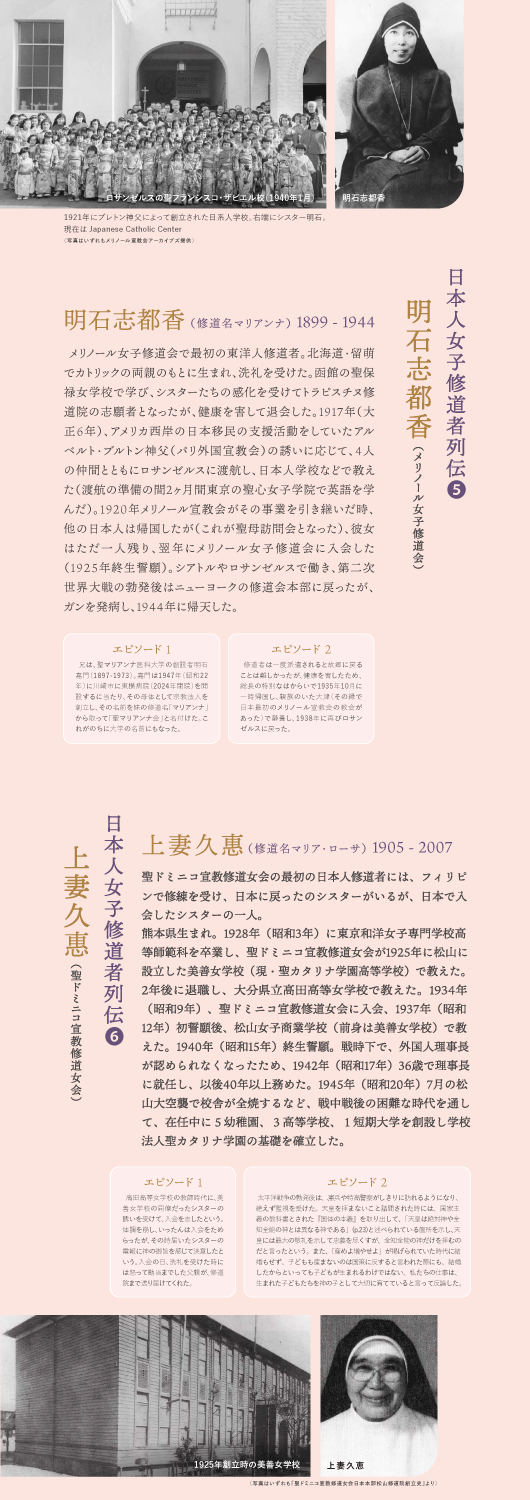
Vol. 4: Kiku Makino (Congregation of the Sisters of Saint Francis of the Martyr St. George )
Kiku Makino (1895–1996) (religious name: Helena)
The second Japanese religious sister in the Congregation of the Sisters of Saint Francis of the Martyr St. George. She was born as the fourth of ten children in Echiizen-cho, Toyama City. Prompted by her elder brother becoming a Christian, she received baptism as a Protestant in 1917 (Taishō 6). After her father moved to Otaru Ward, Hokkaido (later Otaru City), Kiku began attending the Otaru Catholic Church while working as a teacher there and converted to Catholicism under the guidance of a German priest in 1924 (Taishō 13). Two years after her baptism, she entered the order's Sapporo Maria Convent. Thereafter, she taught at the Sapporo Fuji Girls' High School and built the school's foundation. In 1941 (Showa 16), she was appointed principal of Sapporo Fuji Girls' High School and subsequently served in various key positions, such as president of Fuji Women's Junior College in 1950 (Showa 25) and president of Fuji Women's University and chairperson of the Fuji Women's Institute school corporation in 1961 (Showa 36), supporting the academy. During this time, she was in charge of religious studies and ethics and conveyed the spirit of Catholicism to many students. She passed away on June 27, 1996 (Heisei 8), at the age of 101.
Sapporo Fuji Girls’ High School (founded in 1925).
(All photographs courtesy of the Fuji Women’s University Archives.)
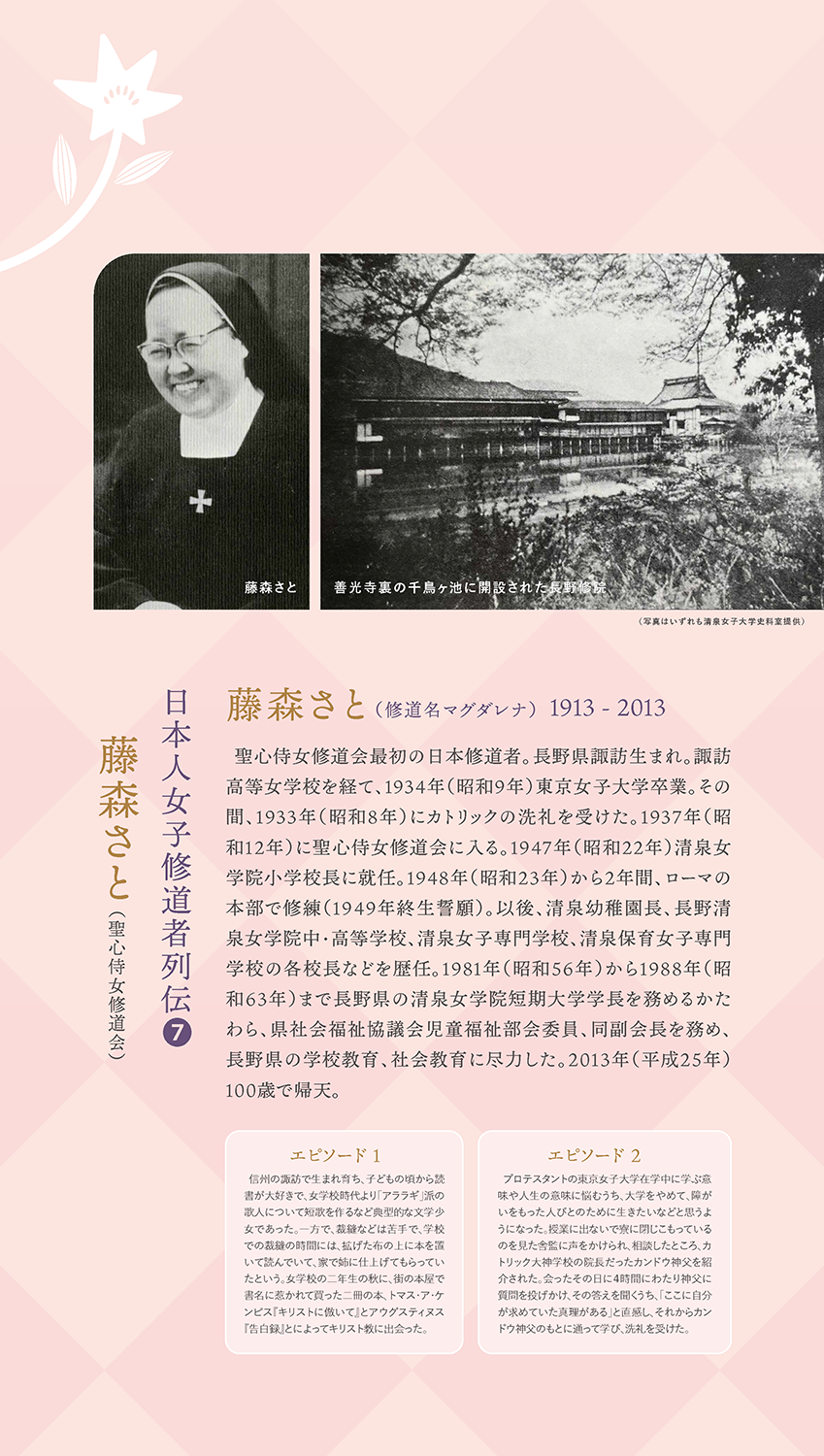
Vol. 5: Shizuka Akashi (Maryknoll Sisters)
Shizuka Akashi (1899–1944) (religious name: Marianna)
The first person of East Asian descent to become a religious sister in the Maryknoll Sisters. She was born to Catholic parents in Rumoi, Hokkaido, and received baptism. She studied at St. Paul's Girls' School in Hakodate and, influenced by the sisters, became an applicant at Our Lady of the Angels Trappistine Abbey of the Order of Cistercians but left owing to poor health. In 1917 (Taishō 6), in response to an invitation from Father Albert Breton (Paris Foreign Missions Society), who was supporting Japanese immigrants on the west coast of the United States, she traveled to Los Angeles with four companions and taught at Japanese schools (during the two-month preparation period for the voyage, she studied English at the Sacred Heart School in Tokyo). When the
Maryknoll Fathers & Brothers took over the work in 1920; the other Japanese returned to Japan (which became the Visitation Sisters), but she alone remained and joined the Maryknoll Sisters the following year (taking her final vows in 1925). She worked in Seattle and Los Angeles and, after the outbreak of World War II, returned to the order's headquarters in New York but developed cancer and passed away in 1944.
Episode 1:
Her elder brother was Yoshitomo Akashi (1897–1973), the founder of St. Marianna University School of Medicine. When Yoshitomo established the Toyoko Hospital (closed in 2024) in Kawasaki City in 1947, he founded a Catholic religious corporation as its parent body and named it the "St. Marianna Society," taking the name from his sister's religious name, "Marianna." This later became the name of the university.
Episode 2:
Once a religious sister was dispatched, it was difficult to return to their hometown, but because of poor health, she temporarily returned to Japan in October 1935 through a special arrangement by the Mother General. She recuperated in Otsu (where the first Maryknoll Fathers & Brothers church in Japan was located due to this connection) with relatives and returned to Los Angeles again in 1938.
St. Francis Xavier School in Los Angeles (January 1940),
a Japanese American school founded in 1921 by Father Breton. Sister Akashi is at the far right. The site is now the Japanese Catholic Center.
(All photographs courtesy of the Maryknoll Fathers & Brothers Archives.)
Vol. 6: Hisae Kozuma (Missionary Sisters of St. Dominic)
Hisae Kozuma (1905–2007) (religious name: Maria Rosa)
Among the first Japanese religious sisters in the Missionary Sisters of St. Dominic, there were two who received their novitiate in the Philippines and returned to Japan; she was one of the sisters who entered the order in Japan.
Born in Kumamoto Prefecture, she graduated from the Wayo Higher Normal School for Women in Tokyo in 1928 and taught at the Bizen Girls' School (now St. Catalina Gakuen High School), which the Dominican Missionary Sisters established in Matsuyama in 1925. She retired two years later and taught at Oita Prefectural Takada Girls' High School. In 1934, she entered the Missionary Sisters of St. Dominic, and after her first vows in 1937, she taught at Matsuyama Girls' Commercial High School (formerly Bizen Girls' School). She took her final vows in 1940. During the war, as foreign chairpersons were no longer permitted, she assumed the position of chairperson of the board at the age of 36 in 1942, a role she held for over 40 years thereafter. Throughout the difficult war and postwar periods, including the complete destruction of the school building in the Matsuyama Great Air Raid of July 1945, she established the foundations of the St. Catalina Gakuen school corporation, founding five kindergartens, three high schools, and one junior college during her tenure.
Episode 1:
It is said that during her time as a teacher at Takada Girls' High School, she received an invitation from a sister who was a colleague at Bizen Girls' School and decided to join the order. She fell ill and once hesitated to enter, but at that time, she felt God's will in a telegram that arrived from the sister and made her decision. On the day she entered the convent, her father, who had been angry at her baptism enough to disown her, drove her there.
Episode 2:
After the outbreak of the Pacific War, military police and the Tokkō began to visit frequently, and she was constantly monitored. When questioned about not bowing to the Emperor, she took out the "Kokutai no Hongi" (Cardinal Principles of the National Entity), which was used as a textbook for nationalism, and pointed to passages that stated the Emperor was a different kind of god from the absolute or omnipotent God. She said that she would show maximum respect and loyalty to the Emperor, but would only worship the omnipotent God. Moreover, when she was told that remaining unmarried or not having children in an era that promoted the slogan "Ume yo fuyase yo" (Bear and Multiply) went against national policy, she retorted by saying that marriage does not necessarily result in children and that their work was to carefully raise the children who were born so that they would not die.
Bizen Girls’ School at the time of its founding in 1925.
(All photographs from "The Founding History of the Matsuyama Convent of the Missionary Sisters of St. Dominic, Japan Province.")
Vol. 7: Sato Fujimori (Handmaids of the Sacred Heart of Jesus)
Sato Fujimori (1913–2013) (religious name: Magdalena)
The first Japanese religious sister in the Handmaids of the Sacred Heart of Jesus. Born in Suwa, Nagano Prefecture, she graduated from Suwa Girls' High School and then from Tokyo Woman's Christian University in 1934 (Showa 9). During that time, she received Catholic baptism in 1933 (Showa 8). In 1937 (Showa 12), she entered the Handmaids of the Sacred Heart of Jesus. In 1947 (Showa 22), she became the principal of Seisen Jogakuin Elementary School. From 1948 (Showa 23) for two years, she underwent formation at the headquarters in Rome (taking her final vows in 1949). Thereafter, she served as principal of Seisen Kindergarten, Nagano Seisen Girls’ Junior and Senior High School, Seisen Women's Vocational School, and Seisen Women’s College of Early Childhood Education, among others. From 1981 (Showa 56) to 1988 (Showa 63), while serving as the president of Nagano Seisen Jogakuin College, she also served as a committee member of the Children's Welfare Department of the Prefectural Council of Social Welfare and as its vice-chairperson, contributing to school education and social education in Nagano Prefecture. She passed away in 2013 (Heisei 25) at the age of 100./p>
Episode 1:
She was born and raised in Suwa, Shinshu (Nagano); loved reading from a young age; and was a typical literary girl, even composing tanka poetry about "Araragi" school poets during her girls' school days. However, she was poor at sewing; during sewing class at school, she would place a book on the spread-out fabric and read it, and have her older sister finish the work at home. In the autumn of her second year of girls' school, she encountered Christianity through two books she bought at a bookstore, attracted by their titles: Thomas à Kempis' "The Imitation of Christ" and Augustine's "Confessions."
Episode 2:
While attending Tokyo Women's Christian University as a Protestant, she agonized over the meaning of learning and life, and began to contemplate quitting university and living with people with disabilities. The dormitory manager, who saw her locked in her room instead of attending classes, spoke to her. Upon consultation, she was introduced to Father Candau, who was the president of the Catholic major seminary. The day they met, she asked the priest questions for four hours, and as she listened to his answers, she instinctively felt, "Here is the truth I was seeking," and from then on, she visited Father Candau, studied, and was baptized.
The Nagano Convent, established at Chidorigaike pond behind Zenkō-ji Temple.
(All photographs courtesy of the Seisen Women’s University Archives.)
Exhibit 3
The Voice of Sister Iwashita
(Courtesy of the Fuji Sacred Heart School Archives)

The audio you are listening to is an excerpt (approximately 23 minutes) from an interview with Sister Kiyoko Iwashita, conducted in 1979 by Miyashiro-kai (the Alumnae Association of the University of the Sacred Heart).
- Her encounter with faith; memories of her brother, Soichi Iwashita; her father’s opposition to her baptism (4 minutes)
- Entering the language school of the Sacred Heart School (6 minutes)
- Receiving baptism (6 minutes)
- Studying in London and joining the Society of the Sacred Heart (7 minutes)
Exhibit 4
The Habit of the Society of the Sacred Heart (Replica)
(Image courtesy of the Sacred Heart School Archives)
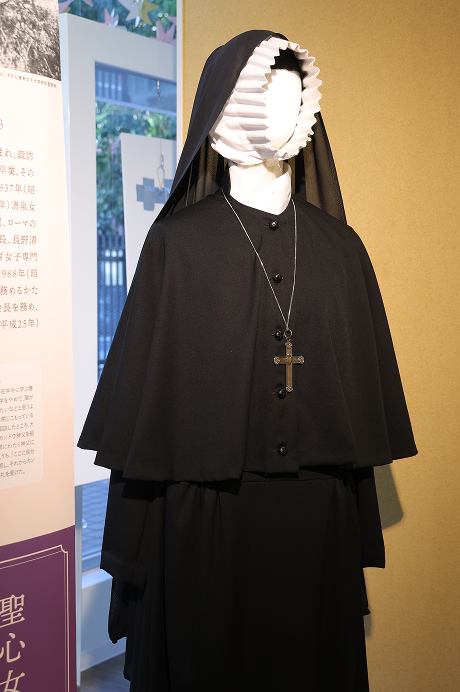
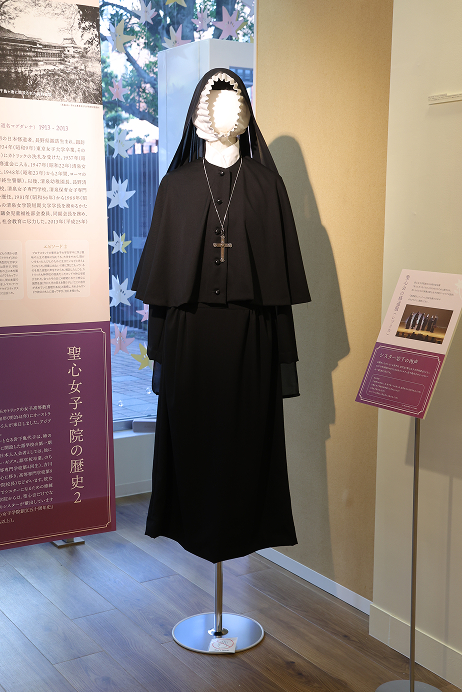
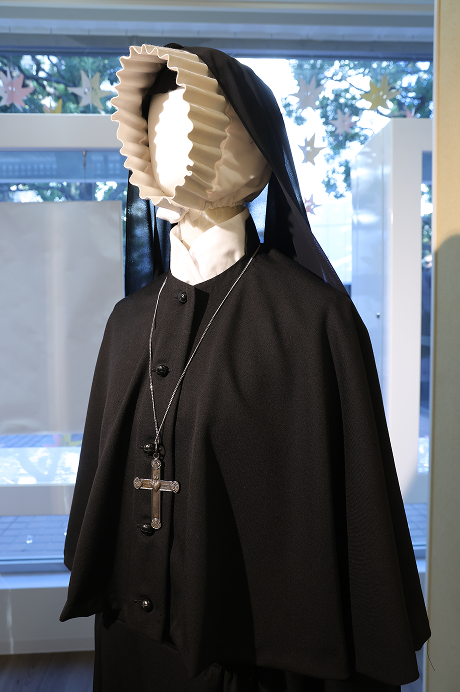
This costume was created and used for the centennial commemorative play What Connects Us (2008), celebrating the 100th anniversary of the founding of the Sacred Heart School for Girls.
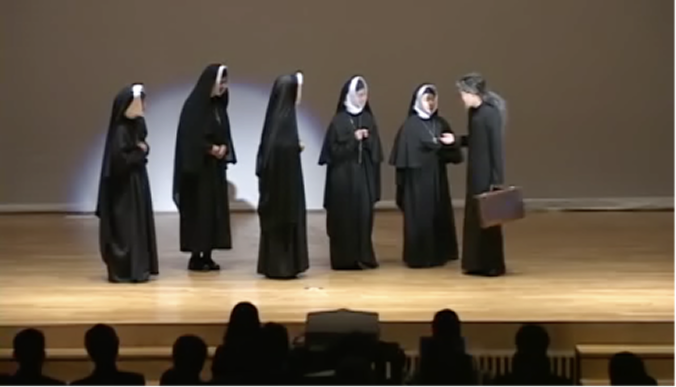
The script of this commemorative play is available in the “Reading Guide” section for your reference.(Image courtesy of the Sacred Heart School Archives)