
Chapter Four
D. “Hope Amid Suffering”
— In the Midst of Darkness
※ Click on the image to view a larger version. PDF File
As Japan moved inexorably toward war, Christianity came to be regarded as the religion of enemy nations and endured a period of severe hardship. Clergy and lay believers alike were subjected to suspicion and repression simply because they were Christians, as a time of oppression returned once more. The Catholic Church, like many other religious bodies, was incorporated into a state system oriented toward war and was compelled to cooperate with it. Yet even in that darkness, Catholicism remained one of the windows through which a light of hope shone for those who sought justice and peace.
“The light shines in the darkness, and the darkness did not overcome it.” (John 1:5)
Even after the removal of the official notice boards enforcing the ban on Christianity, the Edo-period perception of Christianity as “evil teachings” remained deeply entrenched. Although the Constitution of the Empire of Japan, promulgated in 1889 (Meiji 22), guaranteed freedom of religion, the following year witnessed the issuance of "the Imperial Rescript on Education," which promoted a Confucian-based national morality centered on the Emperor. Patriotic education—such as the public reading of the rescript in schools and acts of reverence toward the emperor’s portrait—was widely practiced, effectively sacralizing the emperor.
Simultaneously, Christianity was criticized as being incompatible with the Imperial Rescript on Education, giving rise to what became known as the controversy of “religion–education conflict.” Mission schools in particular were targeted, and religious instruction and religious ceremonies in schools were prohibited by the Ministry of Education’s Directive No. 12 in 1899. As a result of this climate, during the Hibiya Incendiary Incident of 1905 (Meiji 38)—when crowds opposing the Portsmouth Treaty that ended the Russo-Japanese War turned violent and attacked newspaper offices, government buildings, and police stations—Catholic and Protestant churches were also set on fire and destroyed.
As militarism intensified further, social pressure mounted, and Christianity was repeatedly criticized as being unpatriotic or anti-national. Catholic institutions were also targeted. For example, in 1926 (Taishō 15/Showa 1), a newspaper in Nagasaki published a false report claiming that a graduate of Gyosei Junior High School had refused military service, stirring public opinion. In 1932 (Showa 7), major Tokyo newspapers launched criticisms alleging that Sophia University, Gyosei Junior High School, Kaisei Junior High School, and other institutions were failing to provide “patriotic education.” Simultaneously, the Imperial Army—which had been dispatching officers to boys’ schools for military training—also exerted pressure on these institutions.
Similar pressure was applied in regional areas as well, including Tohoku Girls’ High School in Morioka (present-day Morioka Shirayuri Gakuen) and Kanbayashi Girls’ High School in Kumamoto (present-day Kumamoto Shinai Jogakuin). In particular, on Amami Oshima, which was regarded as strategically important as a military base, the Catholic Oshima Girls’ High School was forced to close in 1934 (Showa 9). Foreign missionaries were expelled, churches were destroyed by local residents hostile to Christianity, and many believers were compelled to sign documents renouncing their faith.
Repression was not limited to Christianity. Among Shinto-affiliated new religious movements, Omoto-kyo—viewed as a threat to State Shinto—was subjected to severe suppression in 1935 (Showa 10). More than 1,000 members were arrested under the Peace Preservation Law, and the organization’s facilities were destroyed.
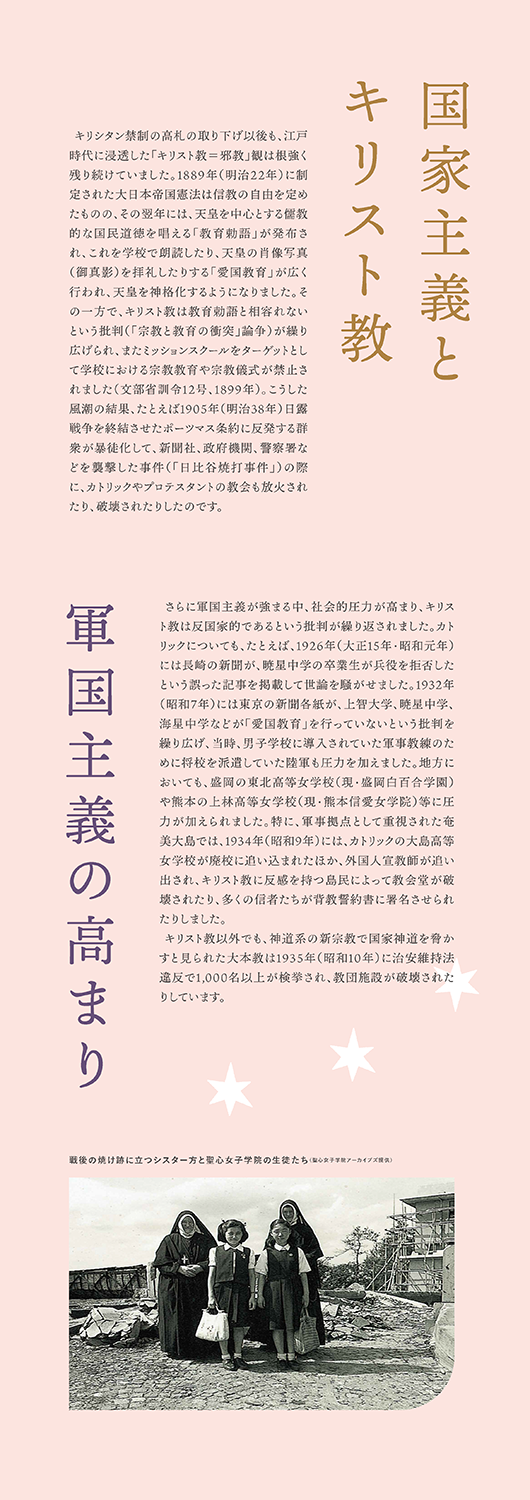
Sisters and students of the Sacred Heart School standing amid the ruins after the war (from Sacred Heart School Archives).
In response to the growing pressure, the Catholic Church began replacing bishops and other diocesan leaders with Japanese clergy. At Catholic schools, as well, principals were appointed from among Japanese staff, and in some cases, school names were changed to more Japanese-sounding ones. Until then, the Church had regarded State Shinto as a religion and had forbidden the faithful from participating in its rites and acts of worship; this policy, however, was reversed.
In 1935 (Showa 10), representatives of Catholic dioceses nationwide—including bishops and apostolic administrators—issued a joint statement affirming a national ideology centered on the “unbroken imperial line” of the emperor. They proclaimed loyalty to the emperor and love of country to be a duty of the faithful, and, as a visible sign of this stance, called for cooperation in fundraising to donate an aircraft to the military. At the same time, the Holy See—hoping that Japan would serve as a counterforce to the spread of communism in China—issued guidelines in 1936 (Showa 11) permitting Catholics to participate in State Shinto rites as expressions of patriotism, even though these rites were religious in nature.
Consequently, Catholic schools widely adopted practices such as the public reading of the Imperial Rescript on Education, reverence for the emperor’s portrait, and "yohai" toward the Imperial Palace (ritual bowing in the direction of the emperor’s residence). With the enactment of the Religious Organizations Law in 1939 (Showa 14), which came into force the following year, the Catholic Church—along with other religious bodies—was placed under the supervision and control of the Ministry of Education with regard to its teachings and activities. This led the Church to become more deeply and actively involved in cooperation with the state system and the war effort.
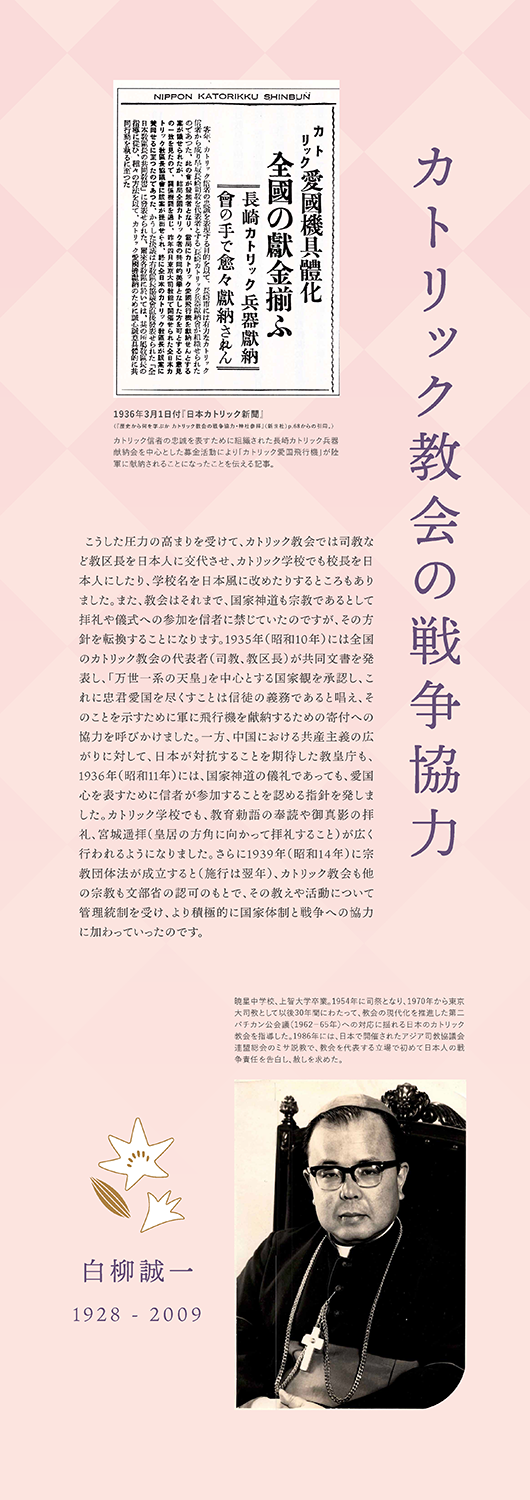
The Japan Catholic Newspaper, March 1, 1936.
An article reported that fundraising activities centered on the Nagasaki Catholic Arms Donation Association—organized to demonstrate the loyalty of Catholic believers—would donate a “Catholic Patriotic Aircraft” to the Imperial Army.
A graduate of Gyosei Junior High School and Sophia University, he was ordained a priest in 1954 and served as Archbishop of Tokyo from 1970. For the next thirty years, he guided the Catholic Church in Japan as it grappled with responses to the Second Vatican Council (1962–1965), which promoted the modernization of the Church. In 1986, during a Mass homily at the General Assembly of the Federation of Asian Bishops’ Conferences held in Japan, he became the first Japanese to confess Japan’s wartime responsibility on behalf of the Church and to ask for forgiveness.
Even after the Catholic Church publicly expressed its cooperation with the wartime system, clergy and believers continued to be viewed with suspicion by society and, in some cases, were subjected to severe persecution.
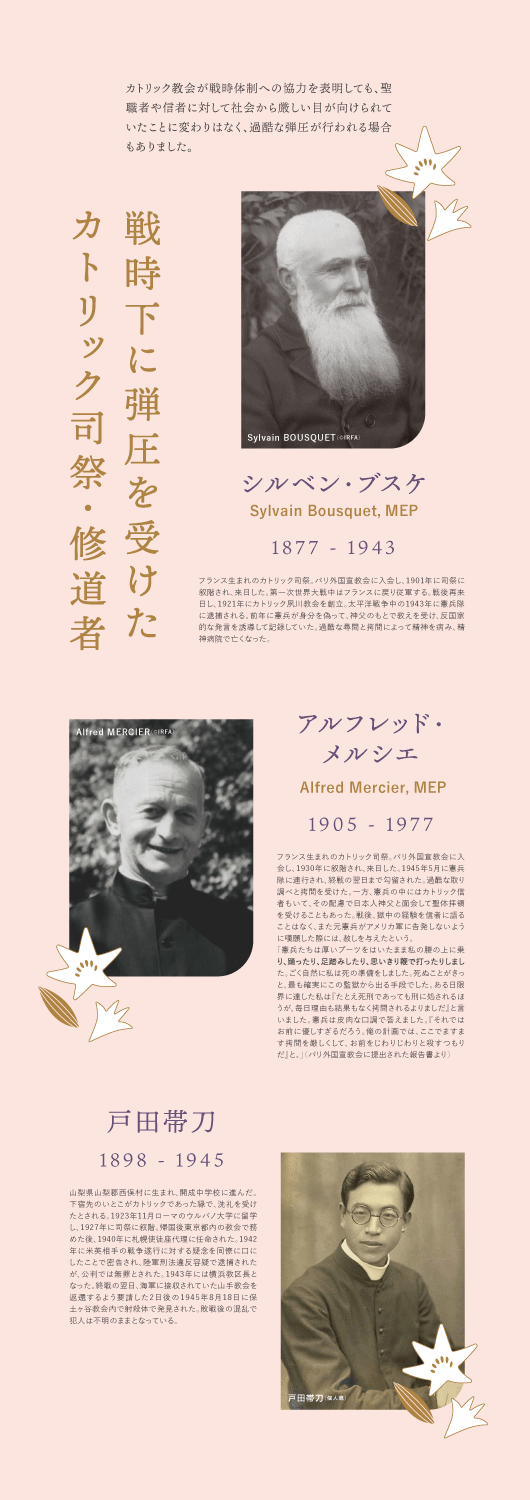
Sylvain Bousquet, MEP (1877–1943)
A French-born Catholic priest, Bousquet, joined the Paris Foreign Missions Society, was ordained in 1901, and came to Japan shortly thereafter. During World War I, he returned to France and served in the military. After the war, he returned to Japan and, in 1921, founded the Catholic Shukugawa Church. In 1943, during the Pacific War, he was arrested by the military police (Kenpeitai). The year before, Kenpeitai officers had posed under false identities to receive instruction from him, deliberately provoking and recording statements deemed anti-state. As a result of brutal interrogations and torture, he suffered a mental breakdown and died in a psychiatric hospital.
Alfred Mercier, MEP(1905–1977)
A French-born Catholic priest, Mercier joined the Paris Foreign Missions Society, was ordained in 1930, and came to Japan. In May 1945, he was taken into custody by the Kenpeitai and detained until the day after the end of the war. He endured severe interrogation and torture. At the same time, some Kenpeitai officers were themselves Catholic, and through their consideration, he was occasionally permitted to meet a Japanese priest and receive Holy Communion. After the war, he never spoke to the faithful about his experiences in prison. When a former Kenpeitai officer later begged him not to be reported to the American authorities, Mercier granted him forgiveness.
“The military police climbed onto my body wearing heavy boots, dancing and stamping on my waist, and whipping me with all their strength. Quite naturally, I prepared myself for death. Dying seemed the surest way to escape this prison. One day, having reached my limit, I said, "Even a death sentence would be better than being tortured every day without reason or outcome." The Kenpeitai replied sarcastically: "That would be too kind for you. My plan is to intensify the torture here and kill you slowly."
(From a report submitted to the Paris Foreign Missions Society)
Tatewaki Toda (1898–1945)
Born in Nishimata Village, Yamanashi District, Yamanashi Prefecture, Toda entered Kaisei Middle School. It is said that he was baptized through the influence of a cousin with whom he lodged, who was Catholic. In November 1923, he went to Rome to study at the Pontifical Urban University and was ordained a priest in 1927. After returning to Japan, he served at churches in Tokyo and was appointed Apostolic Prefect of Sapporo in 1940. In 1942, he was denounced after expressing doubts to a colleague about Japan’s war against the United States and Britain and was arrested on suspicion of violating military law; however, he was acquitted at trial. In 1943, he became head of the Yokohama Diocese. Two days after requesting the return of the Yamate Church, which had been requisitioned by the navy, he was found shot dead inside Hodogaya Church on August 18, 1945, the day after Japan’s surrender. Amid the postwar chaos, the perpetrator was never identified.
Pedro Arrupe, SJ (1907–1991)
Pedro Arrupe was a Catholic priest born in Bilbao, Spain, and later served as the 28th Superior General of the Society of Jesus (1965–1983). He studied medicine at the University of Madrid, entered the Jesuits in 1927, and was ordained a priest in 1936. In 1940, he was sent to Japan and became the pastor of Yamaguchi Catholic Church. From 1942 on, he served as rector of the Jesuit novitiate in Hiroshima. At the time of the atomic bombing of Hiroshima, he devoted himself to caring for the wounded, converting the novitiate into a makeshift hospital and treating approximately 200 victims. After serving as Provincial of the Society of Jesus in the Province of Japan from 1958 to 1965, he was elected Superior General and went on to lead the renewal of the Church and religious life in light of the Second Vatican Council.
"Pedro Arrupe and the Faithful of Yamaguchi"
On December 8, 1941, the very day the Pacific War began, Father Pedro Arrupe was celebrating Mass for "the Feast of the Immaculate Conception" at Yamaguchi Catholic Church. In the midst of the liturgy, he was suddenly arrested by the military police (Kenpeitai). Although he was accused of espionage, no clear explanation was given, and he was taken from the church and detained at Yamaguchi Prison. His correspondence in multiple languages and his ordering of books from Europe and North America were apparently regarded as evidence of spy activity.
On the night of Christmas Eve, half a month after his detention, Alpe was sunk in profound loneliness and suffering in his solitary cell. At that moment, faint Christmas carols drifted in through the window. They were songs he himself had once taught to the faithful at church, now softly sung by believers who had gathered, risking their safety, in an attempt to comfort him. Reflecting on this experience later, Alpe described it as “the deepest spiritual Communion of my life,” recalling that the cell “shone as if it were the manger of Bethlehem.”
Immediately after his arrest, Arrupe was derisively called “Spain” and subjected to humiliating treatment, including having food thrown at him. Interrogations reportedly lasted as long as thirty-seven hours. Yet he sought to steer conversations with the military police toward ordinary topics and, through these exchanges, endeavored to lead them toward God. Moved by his sincerity and humility, the officers gradually laid aside their hostility and began to treat him with courtesy and respect.
After about a month, the charges against him were dropped, and he was released. At the time of his release, many of the military police who had listened to his words reportedly saw him off with deep emotion. Upon his return, the faithful welcomed him with great joy, and he immediately offered a mass of thanksgiving. In the streets thereafter, military police with whom he had grown close during his imprisonment began to greet him affectionately, calling out, “Arupe-san.”
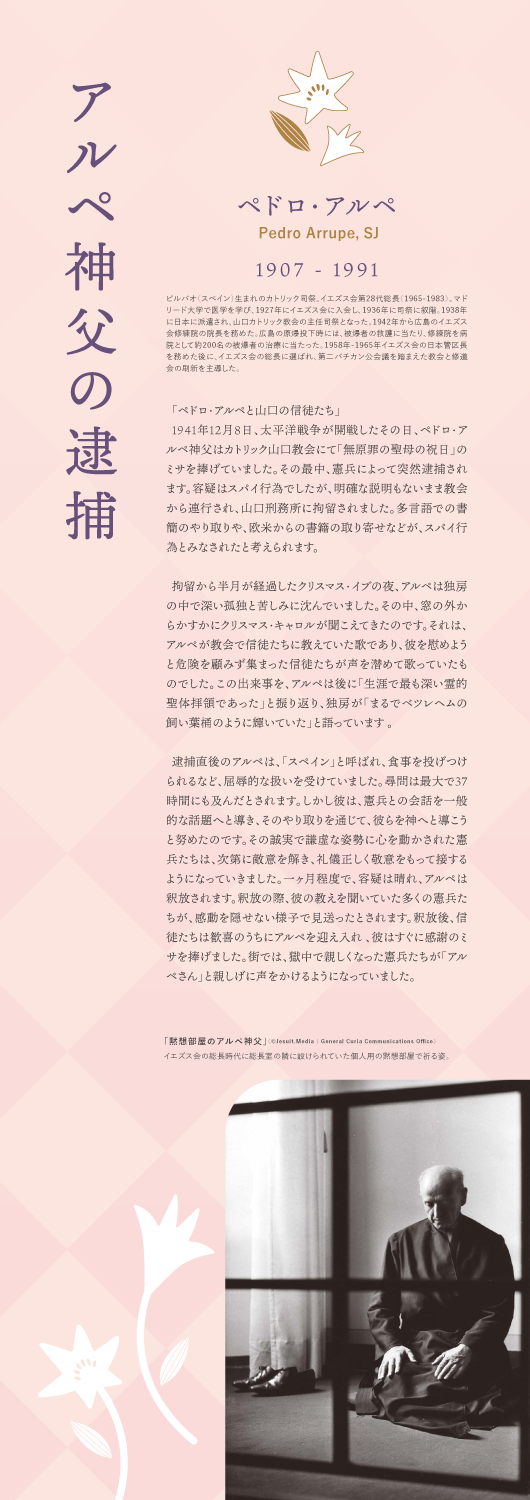
Father Pedro Arrupe in the meditation room
(© Jesuit.Media | General Curia Communications Office).
Shown here praying in his private meditation room, which was located next to the superior general’s office during his tenure as Superior General of the Society of Jesus.
At the outbreak of the Pacific War in 1941 (Showa 16), approximately 900 foreign Catholic clergy (priests and religious) remained in Japan. Among them, priests and religious holding the nationality of countries with which Japan entered a state of war—such as the United States, Great Britain, and other Commonwealth nations (including Canada, Australia, New Zealand, and Ireland)—were detained by the police as “enemy nationals.”
This internment was justified both as a means of preventing espionage, sabotage, or other “acts benefiting the enemy,” such as anti-war activities, and as a measure to protect them from possible harm arising from hostility among the Japanese population. On the day following the outbreak of war, male clergy (priests and brothers) were detained first, and in July 1942, the policy was extended to women religious (sisters), resulting in the internment of many sisters who had been working in schools and hospitals.
Although advance advisories urging repatriation had been issued by countries such as the United States and Great Britain, a relatively large number of Catholic clergy chose to remain in Japan out of commitment to their mission. In principle, they were treated in accordance with the Geneva Convention on the treatment of prisoners of war and were permitted to correspond and receive daily necessities. In practice, however, letters were subject to strict censorship, supplies were sometimes misappropriated, and conditions varied considerably depending on the detention facility.
Elizabeth T. Britt, member of the Society of the Sacred Heart—who later became the first president of the University of the Sacred Heart after the war—was also a United States national and was therefore interned. She left a written account of her experiences, which can be seen in the Exhibition "Commemorating the 75th Anniversary of the University of the Sacred Heart."
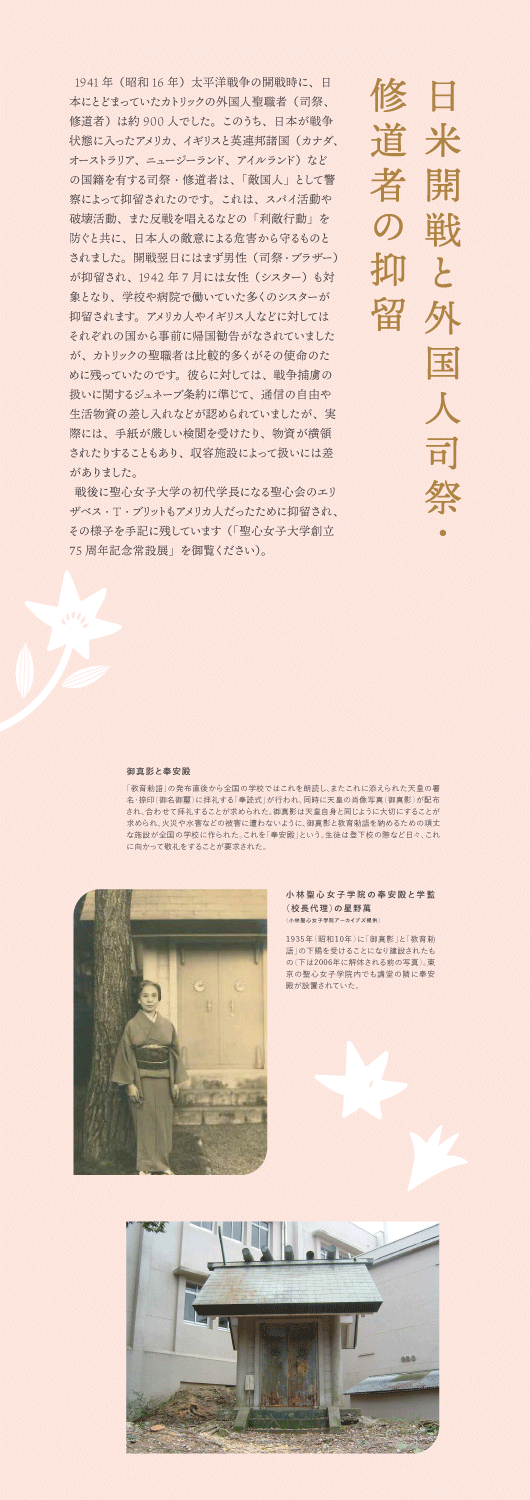
The Imperial Portrait (Goshinei) and the Hōanden.
From shortly after the promulgation of the "Imperial Rescript on Education," schools throughout Japan conducted ceremonies in which the Rescript was read aloud, and homage was paid to the Emperor’s signature and seal (Gomyo Gyoji) affixed to it—ceremonies known as " hodoku-shiki." At the same time, portrait photographs of the Emperor (goshinei) were distributed, and schools were required to pay homage to them as well.
The goshinei were to be treated with the same reverence as the emperor himself. To ensure that the Imperial Portrait and the Imperial Rescript on Education would not be damaged by fire, flooding, or other disasters, sturdy facilities were constructed at schools across the country to house them. These structures were called hōanden. Students were required to bow in respect toward them daily, such as when arriving at or leaving school.
The Hoanden (Imperial Shrine) of Obayashi Sacred Heart School and its first principal (academic director), Yorozu Hoshino
(courtesy of the Obayashi Sacred Heart School Archives).
It was constructed in 1935 (Showa 10) following the bestowal of the Goshinei (Imperial Portrait) and the Imperial Rescript on Education (the photograph below shows the structure before its demolition in 2006). At the Sacred Heart School in Tokyo, as well, a Hoanden was installed next to the auditorium.