
History of Seishin Joshi Gakuin
※ Click on the image to view a larger version. PDF File
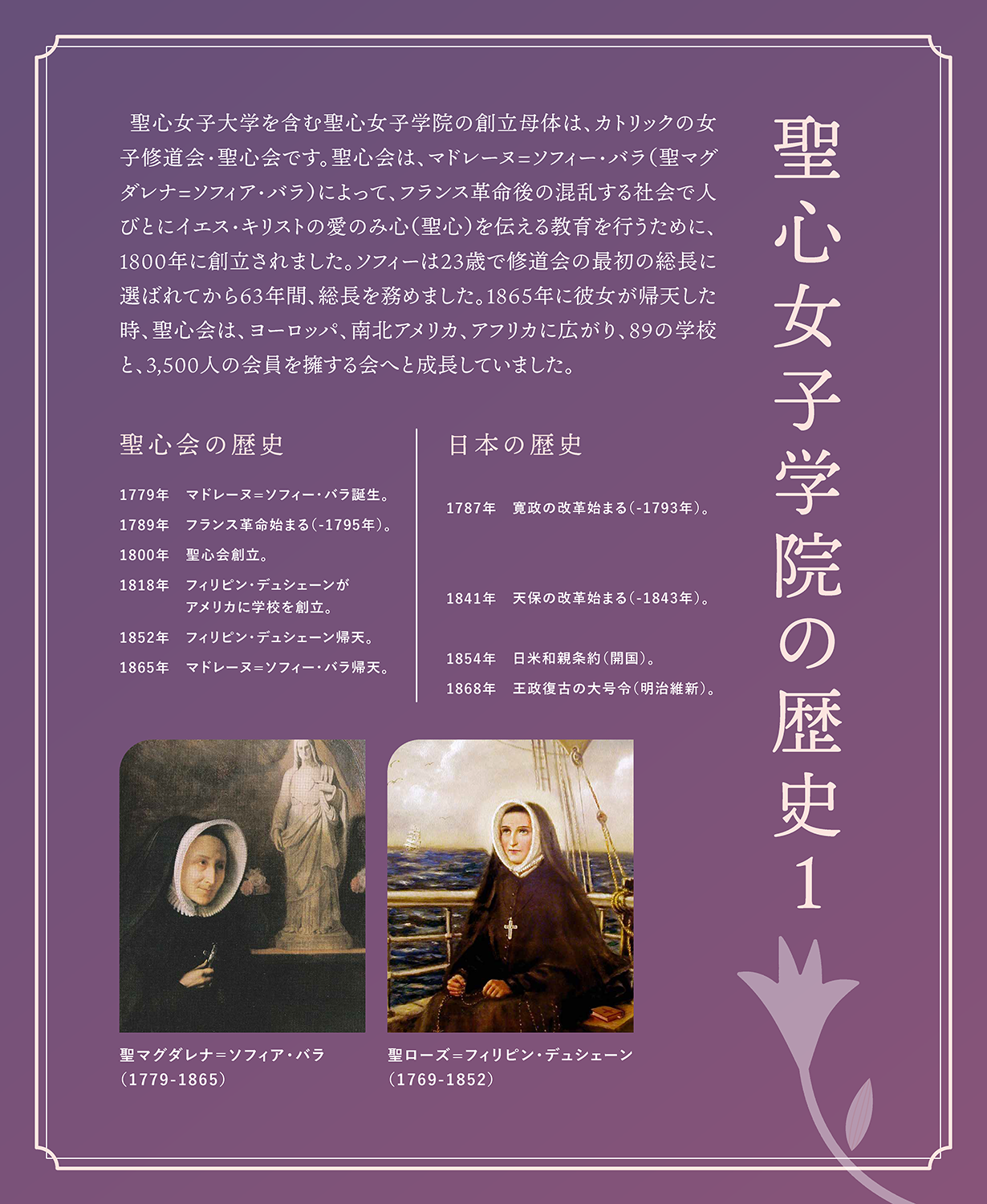
The Catholic women's religious order, the Society of the Sacred Heart, is the founding body of the Seishin Joshi Gakuin, which includes the University of the Sacred Heart. The Society of the Sacred Heart was founded in 1800 by Madeleine-Sophie Barat (Saint Madeleine Sophie Barat) to provide education that conveys the loving Heart of Jesus Christ (the Sacred Heart) to people in the chaotic society following the French Revolution. Sophie was elected the first Superior General of the order at the age of 23 and served in that role for 63 years. When she passed away in 1865, the Society of the Sacred Heart had grown into an association that spread across Europe, North and South America, and Africa, with 89 schools and 3,500 members.
History of the Society of the Sacred Heart
1779: Madeleine-Sophie Barat was born.
1789: The French Revolution began. (-1795).
1800: The Society of the Sacred Heart was founded.
1818: Philippine Duchesne founded a school in America.
1852: Philippine Duchesne passed away.
1865: Madeleine-Sophie Barat passed away.
History of Japan
1787: The Kansei Reforms began. (-1793)
1841: The Tenpo Reforms began (-1843)
1854: The Treaty of Peace and Amity between the US and Japan (Opening of Japan)
Saint Magdalene-Sophie Barat (1779–1865)
Saint Rose Philippine Duchesne (1769–1852)
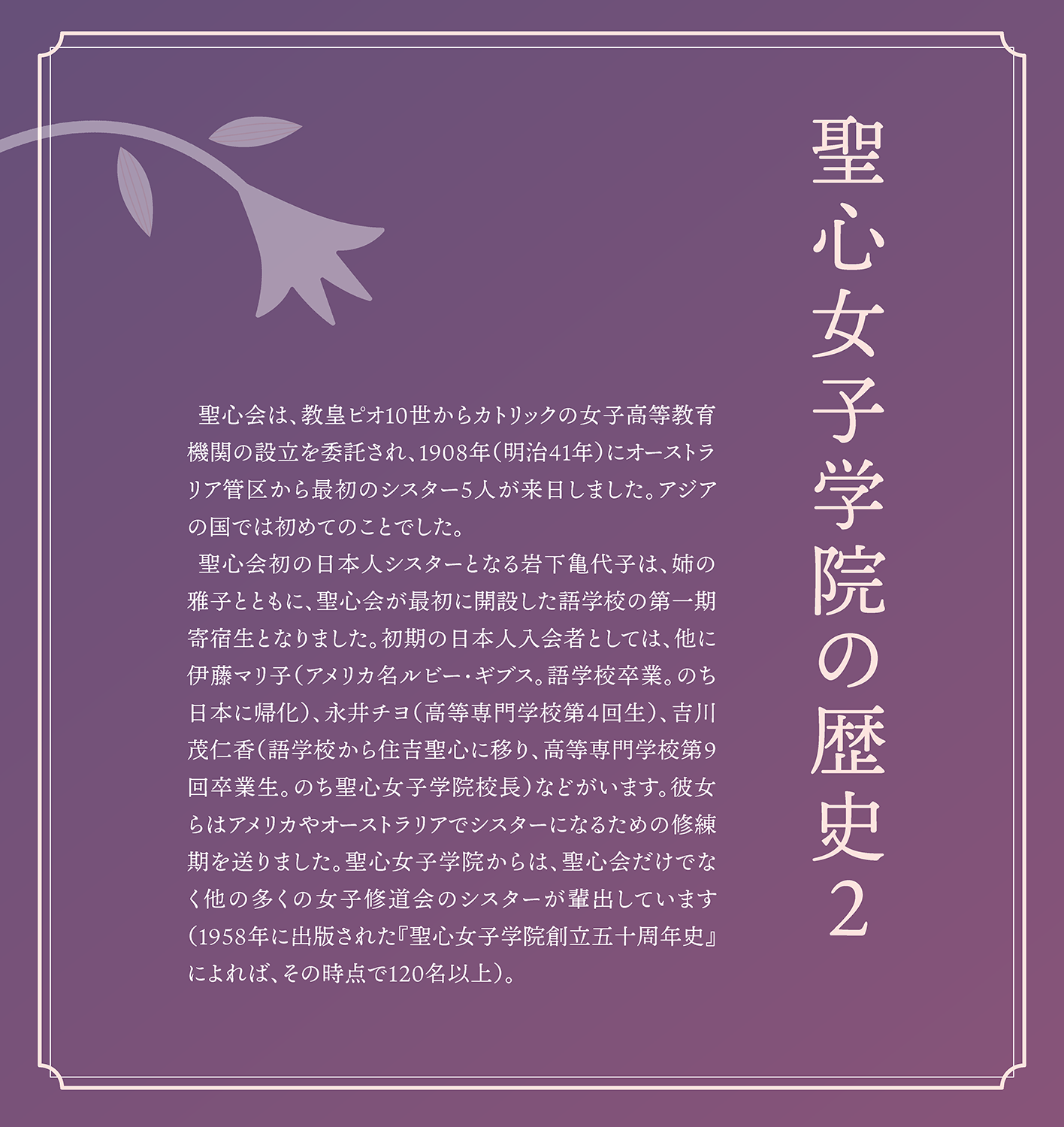
The Society of the Sacred Heart was commissioned by Pope Pius X to establish Catholic higher education institutions for women, and in 1908 (Meiji 41), the first five sisters arrived in Japan from the Australian province. This was their first visit to Japan.
Kiyoko Iwashita, who would become the first Japanese sister at the Society of the Sacred Heart, became a first-term boarding student at Sacred Heart Gogakko (language school), first opened by the Sacred Heart, along with her older sister, Masako. Other early Japanese entrants included Mariko Ito (American name Ruby Gibbs, a Gogakko graduate who later naturalized in Japan), Chiyo Nagai (4th-year graduate of the Sacred Heart Senmon Gakko), and Monika Yoshikawa (who transferred from the Gogakko to Sumiyoshi Sacred Heart, a 9th graduate of Sacred Heart Senmon Gakko, and later became principal of Sacred Heart School). These women spent their novitiate periods in the United States or Australia to become sisters. Many sisters from the Sacred Heart School have gone on to join not only the Society of the Sacred Heart but also many other women's religious institutes (according to the 50th Anniversary History of the Founding of Sacred Heart School, published in 1958, there were more than 120 at that time).
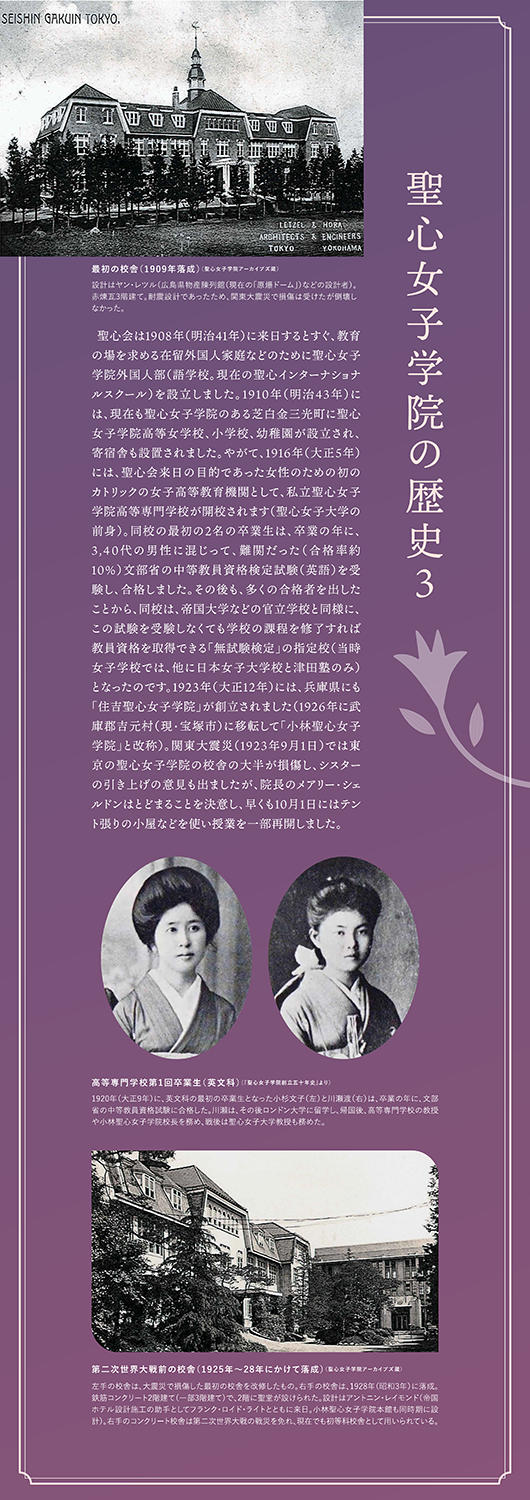
Upon arriving in Japan in 1908 (Meiji 41), the Society of the Sacred Heart promptly established the Foreign Department of the Sacred Heart School for Girls (Gogakko, which later became what is now known as the International School of the Sacred Heart)—a language school created to meet the educational needs of foreign families residing in Japan. In 1910 (Meiji 43), the Society of the Sacred Heart opened an elementary school, a kindergarten, and a girls' high school in Shiba-Shirokane Sankocho, where the school is still located today, and also established a boarding facility.
In 1916 (Taishō 5), the Sacred Heart Senmon (Higher School of Professional Studies) was opened as the first Catholic institution of higher education for women, fulfilling the original purpose of the society’s mission in Japan. This school later became the University of the Sacred Heart. The school’s first two graduates, in the year of their graduation, sat for and passed the highly competitive Ministry of Education Secondary School Teacher Certification Examination (English), which had a pass rate of approximately 10 percent, competing alongside men in their thirties and forties. As the school continued to produce many successful candidates, it was eventually designated as an institution authorized to grant teaching qualifications upon completion of its curriculum without requiring the examination—a status known as “certification without examination.” At the time, among women’s schools, only Japan Women’s University and Tsuda College shared this designation.
In 1923 (Taishō 12), the Sumiyoshi Sacred Heart School was founded in Hyogo Prefecture. In 1926, it was relocated to Yoshimoto Village in Muko District (present-day Takarazuka City) and renamed Obayashi Sacred Heart School.
During the Great Kanto Earthquake on September 1, 1923, most of the buildings of the Sacred Heart School in Tokyo were severely damaged, and there were voices calling for the sisters to withdraw. However, the headmistress, Mary Sheldon, chose to stay and partially resumed classes using tents and temporary structures as early as October 1.
The first school building (completed in 1909) (from the Sacred Heart School Archives).
It was designed by Jan Letzel, the architect also known for the Hiroshima Prefectural Commercial Exhibition Hall (now the Atomic Bomb Dome). The three-story red-brick building was earthquake-resistant; although it was damaged in the Great Kanto Earthquake, it did not collapse.
The first graduating class of the Sacred Heart Senmon Gakko (English Department) (from Fifty-Year History of the Sacred Heart School).
In 1920 (Taishō 9), Fumiko Kosugi (left) and Wataru Kawase (right), the first graduates of the English Department, passed the Ministry of Education’s examination for secondary school teacher qualification in their year of graduation. Kawase later studied at the University of London and, after returning to Japan, served as a professor at the Senmon ( Higher Specialized School) and as principal of Obayashi Sacred Heart School. After the war, she also served as a professor at the University of the Sacred Heart.
Prewar school buildings (from the Sacred Heart School Archives)
The building on the left is a renovation of the original school building that was damaged in the Great Kanto Earthquake. The building on the right was completed in 1928 (Showa 3). It is a two-story reinforced-concrete structure (partly three stories) with a chapel on the second floor. It was designed by Antonin Raymond, who came to Japan with Frank Lloyd Wright as an assistant in the design and construction of the Imperial Hotel; he also designed the main building of Obayashi Sacred Heart School around the same period.
The concrete building on the right escaped damage during World War II and continues to be used till date as the elementary school building.
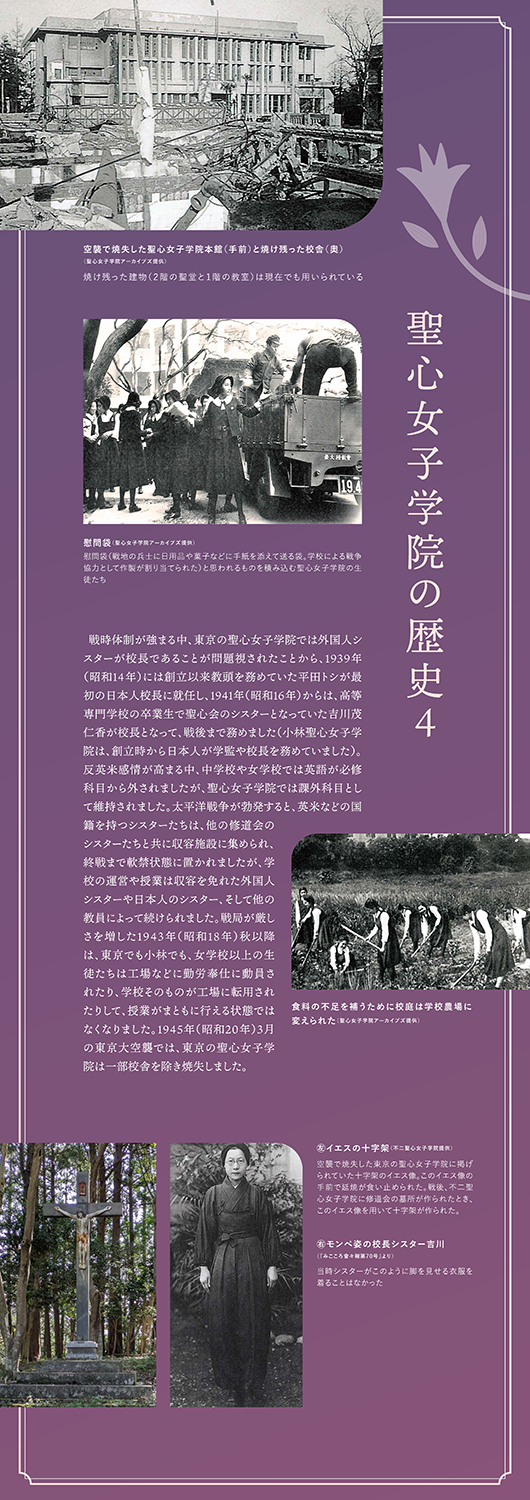
As the wartime regime intensified, the fact that the principal of the Sacred Heart School in Tokyo was a foreign sister came to be regarded as problematic. As a result, in 1939 (Showa 14), Toshi Hirata—who had served as vice-principal since the school’s founding—was appointed as the first Japanese principal. From 1941 (Showa 16), the position was held by Monika Yoshikawa, a graduate of a Senmon Gakko who had entered the Society of the Sacred Heart; she served as principal until the end of the war. (At the Sacred Heart School in Obayashi, Japanese educators had served as academic directors and principals from the time of its founding.)
As anti-British and anti-American sentiment grew, English was removed from the list of compulsory subjects at middle schools and girls’ schools throughout Japan. At Sacred Heart School, however, it was retained as an extracurricular subject. When the Pacific War broke out, sisters holding nationalities of the United States, Britain, and other enemy countries were gathered together with sisters from other religious congregations and placed in internment facilities, where they remained under restricted confinement until the end of the war. Nevertheless, the operation of the school and the continuation of classes were maintained by foreign sisters who were exempt from internment, Japanese sisters, and other teachers.
From the autumn of 1943 (Showa 18), as the war situation grew increasingly severe, students at girls’ schools and above, both in Tokyo and in Obayashi, were mobilized for labor service at factories, and in some cases, school buildings themselves were converted into factories. Under these circumstances, normal instruction became virtually impossible. In the Tokyo air raids of March 1945 (Showa 20), most of the buildings of the Sacred Heart School in Tokyo were destroyed by fire, with only a portion of the campus remaining intact.
The main building of the Sacred Heart School that was destroyed by air raids (foreground), and the school building that survived (background). (courtesy of the Sacred Heart School Archives).
The surviving structure—comprising the chapel on the second floor and classrooms on the first floor—is still in use today.
Students of the Sacred Heart School loading what appear to be “comfort bags.” (courtesy of the Sacred Heart School Archives).
These bags, containing daily necessities and sweets along with letters, were sent to soldiers at the front and were produced as part of schools’ assigned wartime cooperation.
The school grounds converted into a school farm. (courtesy of the Sacred Heart School Archives).
This was done to help make up for food shortages.
The Cross of Jesus (courtesy of Fuji Sacred Heart School).
Air raids destroyed the Sacred Heart School in Tokyo, which had displayed this figure of Jesus on the cross. The spread of the fire was stopped in front of this figure. After the war, when a convent cemetery was established at Fuji Sacred Heart School, a cross was made using this figure of Jesus.
Principal Sister Yoshikawa wearing monpe work trousers. (from Mikokoro Kai Newsletter, No. 70).
At the time, sisters did not wear clothing other than their religious habits.