
Chapter One
The Impact of the “Discovery of the Hidden Christians”
— The Morning Star
※ Click on the image to view a larger version. PDF File
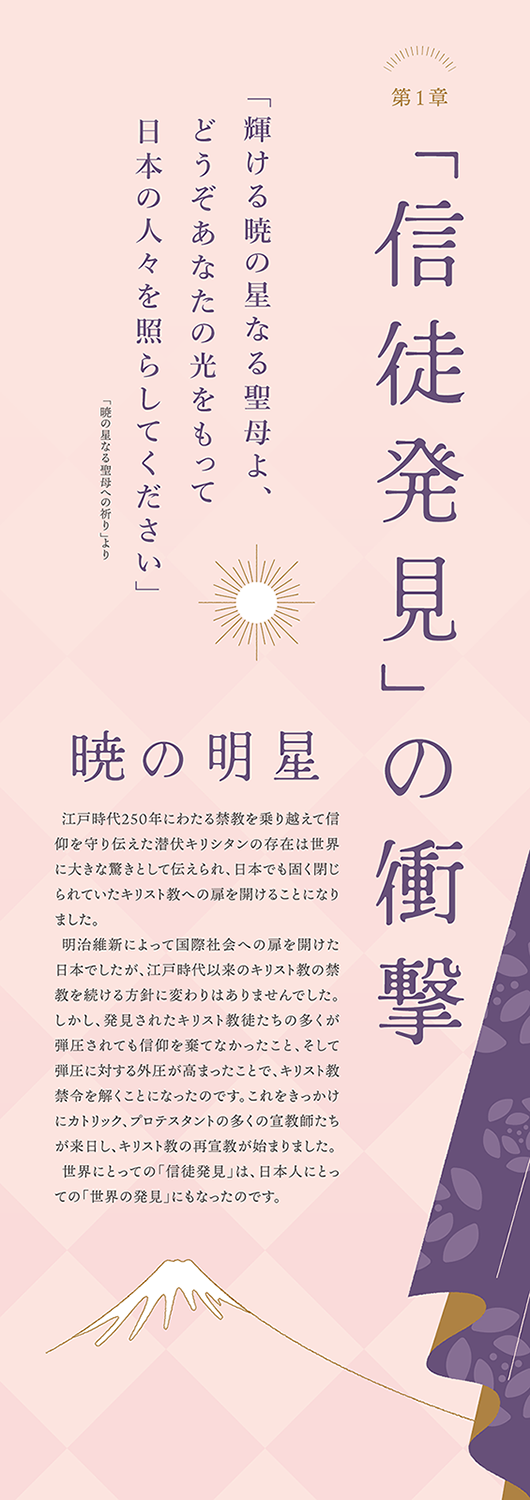
The existence of the Hidden Christians, who had preserved and handed down their faith despite 250 years of prohibition during the Edo period, was conveyed to the world as a great astonishment. It also opened the door to Christianity that had long been firmly closed in Japan.
Although Japan opened its doors to the international community with the Meiji Restoration, initially, no change was observed in the policy of continuing the ban on Christianity that had been in place since the Edo period. However, the fact that many of the discovered Christians did not renounce their faith even under persecution, together with growing international pressure against such oppression, eventually led to the lifting of the ban on Christianity. This led to many Catholic and Protestant missionaries coming to Japan, marking the beginning of the re-evangelization of Christianity. The discovery of the Hidden Christians for the world was also a discovery of the world for the Japanese people.
“O Mary, bright Morning Star, shine sweetly upon the people of Japan.” from “The Prayer to Mary, Morning Star.”
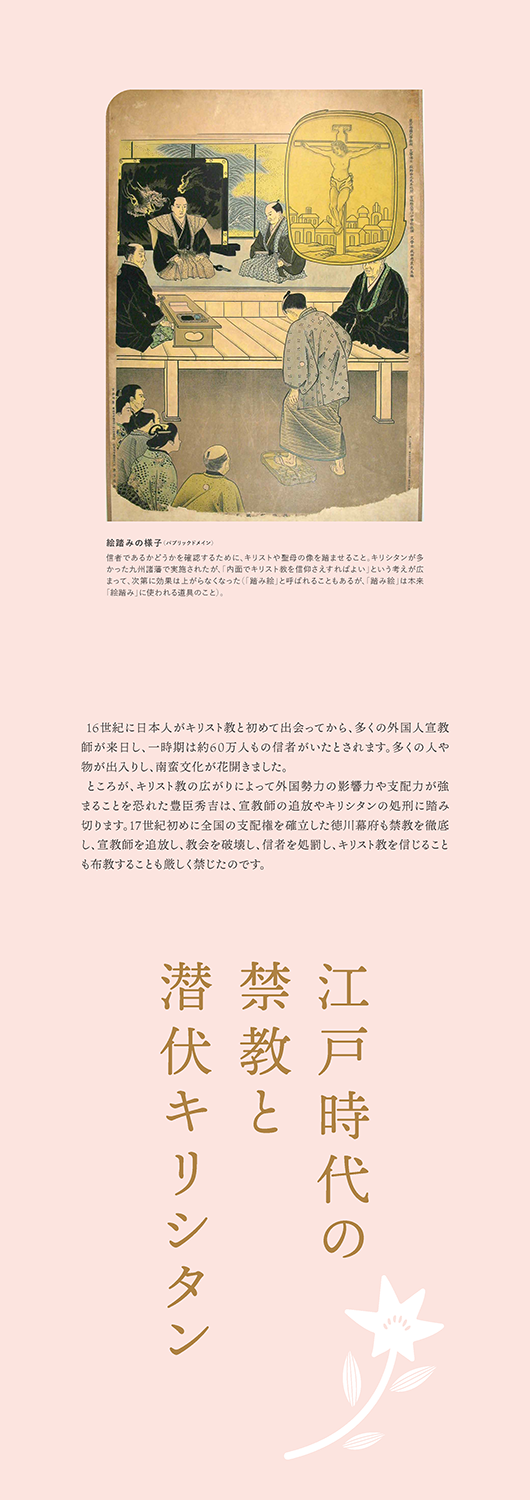
From the time the Japanese first encountered Christianity in the 16th century, many foreign missionaries came to Japan, and at its height, the number of believers is said to have reached as many as 600,000. The movement of people and goods increased, and Nanban culture flourished. However, Toyotomi Hideyoshi, fearing that the spread of Christianity would strengthen the influence and control of foreign powers, began to expel missionaries and execute Christians. In the early 17th century, the Tokugawa shogunate, having established nationwide authority, enforced the prohibition of Christianity even more strictly. Missionaries were expelled, churches destroyed, believers punished, and both the practice and propagation of Christianity were harshly forbidden.
“The Scene of Efumi (Public Domain)”
Efumi was a practice in which people were made to step on images of Christ or the Virgin Mary to determine whether they were Christians. It was carried out mainly in the Kyushu region, where many Christians lived. However, as the idea spread that one could maintain Christian faith inwardly regardless of outward actions, the practice gradually lost its effectiveness. (The term "Fumie" is sometimes used, but strictly speaking, "Fumie" refers to the images used in the practice of Efumi.)
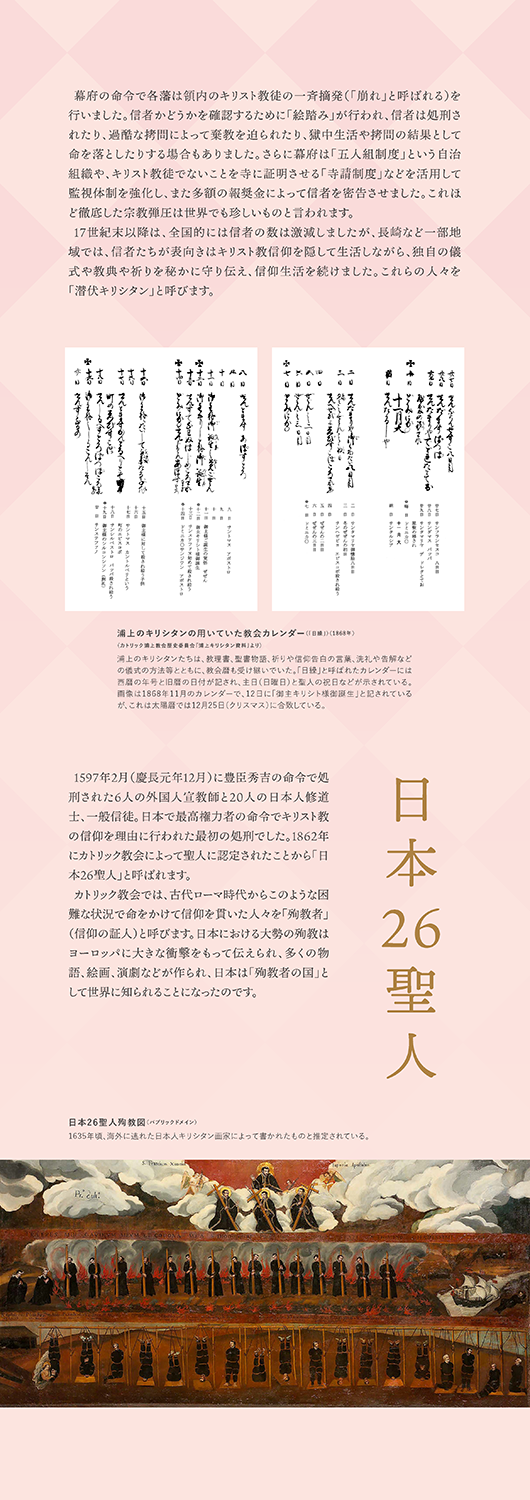
By order of the shogunate, each domain carried out mass arrests of Christians within its territory, an action known as Kuzure (“the roundup”). To determine whether individuals were believers, the practice of Efumi—forcing people to trample on images of Christian figures—was imposed. Believers were executed, subjected to severe torture to force apostasy, or sometimes lost their lives as a result of imprisonment and torture.
Furthermore, the shogunate strengthened its surveillance system through measures such as the "Goningumi system," a form of mutual-responsibility community organization, and the "Terauke system," which required temples to certify that individuals were not Christians. Large monetary rewards were also offered for informing on believers. Such a thorough and systematic persecution of religion is said to be rare even by global standards.
From the late 17th century onward, the number of believers declined drastically nationwide. However, in certain regions, such as Nagasaki, Christians continued to live, outwardly concealing their faith while secretly preserving and passing down their own rituals, sacred texts, and prayers, maintaining their religious lives in secrecy. These people are known as the “Hidden Christians.”
Church Calendar (Higuri) used by the Urakami Christians (1868) (From Urakami Christian Materials, Catholic Urakami Church Historical Committee)
The Urakami Christians preserved the liturgical calendar of the Church along with catechisms, biblical stories, prayers, professions of faith, and the rites for sacraments such as baptism and confession. The calendar, known as "Higuri," records both the Western calendar year and dates according to the traditional lunar calendar, indicating Sundays and feast days of saints. The picture depicts the calendar for November 1868. On the 12th reads “The Birth of Our Lord Jesus Christ,” which corresponds to December 25 (Christmas) in the solar calendar.
In February 1597 (the 12th month of Keichō 1), six foreign missionaries and twenty Japanese monks and lay people were executed by the order of Toyotomi Hideyoshi. This was the first execution in Japan carried out under the highest authority of the country solely because of their Christian faith. As they were canonized by the Catholic Church in 1862, they have been called the “26 Martyrs of Japan.”
In the Catholic Church, people who sacrificed their lives under such difficult circumstances have long been called “martyrs” (witnesses of faith). The large-scale martyrdoms in Japan made a profound impact on Europe, inspiring numerous stories, paintings, and theatrical works. Consequently, Japan became known to the world as “the country of martyrs.”
The Twenty-Six Martyrs of Japan.
About 1635, believed to have been painted by a Japanese Christian artist who fled overseas.
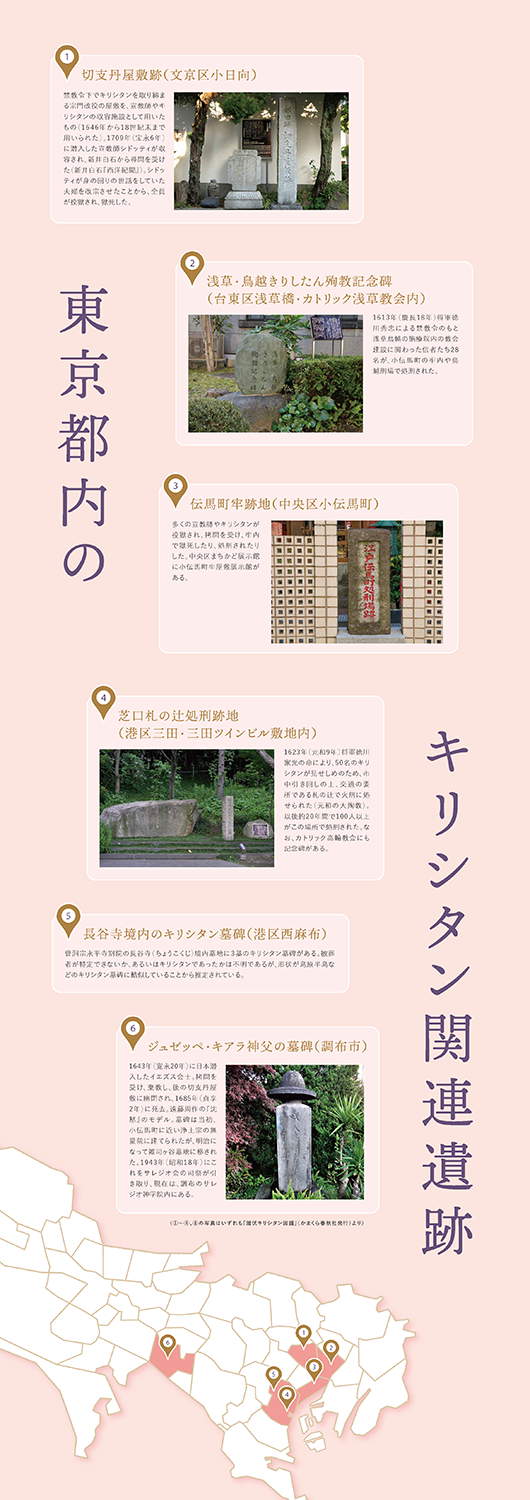
① Site of the Christian Residence (Kohinata, Bunkyo Ward)
Under the anti-Christian edicts, this residence of officials overseeing religious affairs was used as a detention facility for missionaries and Christians (from 1646 to the late 18th century). In 1709, the missionary Giovanni Battista Sidotti was confined here and interrogated by Arai Hakuseki (from Arai Hakuseki's "Seiyō Kibun"). After Sidotti converted the couple who took care of him, they were all imprisoned and died in custody.
② Asakusa Torigoe Christian Martyrdom Monument (Taito Ward, Asakusabashi, inside the Catholic Asakusa Church)
In 1613, under the anti-Christian edicts of Shogun Tokugawa Hidetada, 28 believers involved in building a church within a charitable clinic in Asakusa Torigoe were executed—some in the Ko-Tenmamacho prison, others at the Torigoe execution grounds.
③ Site of the Denmacyo Prison (Chuo Ward, Ko-Tenmamachi)
Many missionaries and Christians were imprisoned here, subjected to torture, and either died in custody or were executed. The Chuo Ward Machikado Exhibition Hall has a display on the Ko-Tenmamacho prison.
④ Execution Site at Shibaguchi Fuda-no-Tsuji (Minato Ward, Mita, on the site of Mita Twin Building)
In 1623, by the order of Shogun Tokugawa Iemitsu, 50 Christians were paraded through the city and burned alive at this key intersection as a warning (the Great Martyrdom of Genna). Over the next 20 years, more than 100 people were executed here. A monument also stands at the Catholic Takanawa Church.
⑤ Christian Gravestones on the Grounds of Chokoku-ji (Minato Ward, Nishi-Azabu)
Three gravestones, presumed to be Christian are situated in the cemetery of Chokoku-ji, a branch temple of the Sōtō Zen Eihei-ji. The identities of those buried and their Christian affiliation remain unknown; however, the gravestones’ shapes closely resemble Christian graves found on the Shimabara Peninsula, suggesting their association.
⑥ Tombstone of Father Giuseppe Chiara (Chofu City)
Father Giuseppe Chiara, a Jesuit who entered Japan in 1643, was tortured, forced to renounce his faith, and later confined at the former Christian residence, dying in 1685. He served as the model for Shusaku Endo’s "Silence." His tombstone was originally at the Jōdo sect temple Muryo-in near Kotenmacho, moved to Zoshigaya Cemetery during the Meiji era, and in 1943 was taken by Salesian priests. It now stands at the Salesian Seminary in Chofu.
(Photos for ①–④ and ⑥ are all from "Senpuku Christian Zufu," published by Kamakura Shunjūsha.)*
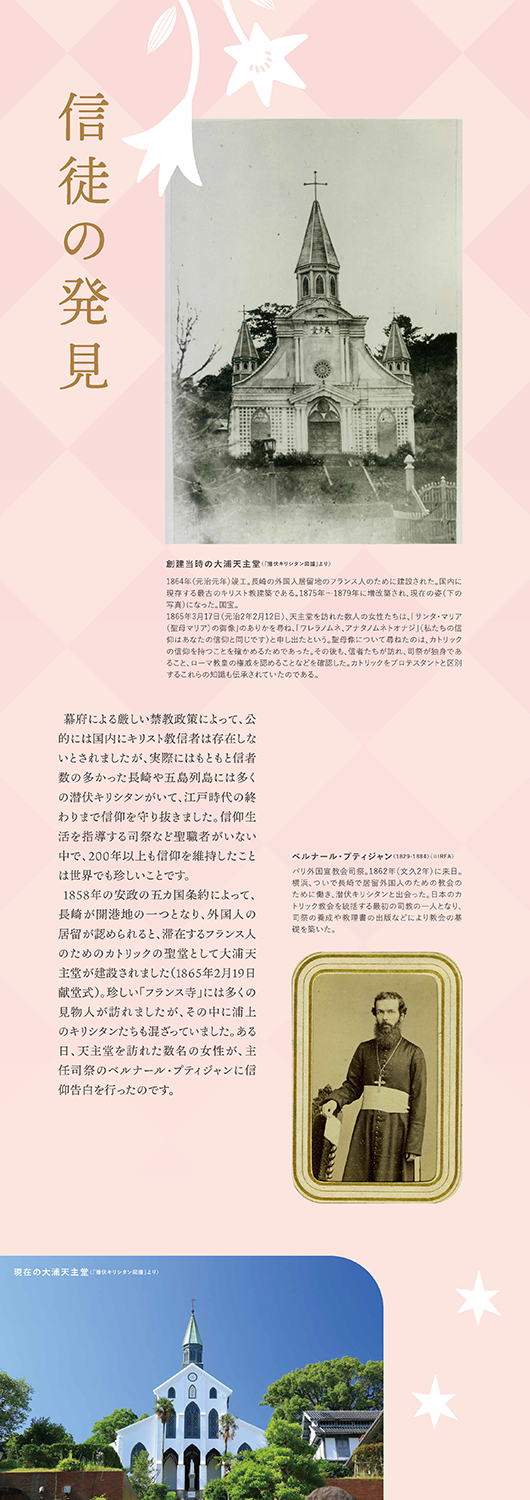
The shogunate’s strict ban on Christianity led to the official belief that no Christians remained in Japan. In reality, however, many Hidden Christians (Senpuku Christians) lived in areas such as Nagasaki and the Goto Islands, where the number of believers had originally been large, and they preserved their faith until the end of the Edo period. It is very exceptional that the Christian faith was maintained for more than 200 years without the presence of priests or other clergy to guide religious life. In 1858, the Ansei Five-Power Treaties designated Nagasaki as one of the open ports, allowing foreigners to reside there. Consequently, Oura Cathedral was constructed as a Catholic church for the French residents living in the city (it was consecrated on February 19, 1865). The strange “French temple” attracted many curious visitors, among whom were Christians from Urakami. One day, several women who visited the cathedral confessed their faith to the parish priest, Bernard Petitjean.
Oura Church at the Time of Its Construction (From "Senpuku Christian Zufu")
Completed in 1864 (Genji 1), Oura Church was built for the French residents of the Nagasaki foreign settlement. It is the oldest surviving Christian building in Japan. Between 1875 and 1879, it was expanded and remodeled into its present form (see photo below). It is designated a National Treasure.
On March 17, 1865 (Genji 2, February 12th), several women visiting the church inquired about the location of the statue of Santa Maria (the Virgin Mary) and declared, “Warera no mune, anata no mune to onaji” (“Our faith is the same as yours”). Their question about the Virgin Mary was meant to verify their Catholic faith. Subsequent visitors were similarly assessed on whether they recognized the authority of the Pope and the celibacy of priests. These exchanges reveal that knowledge distinguishing Catholicism from Protestantism had been carefully preserved among believers.
Bernard Petitjean, MEP (1829–1884) (© IRFA),
a priest of the Paris Foreign Missions Society. He arrived in Japan in 1862 (Bunkyū 2). He served in churches for foreign residents in Yokohama and later in Nagasaki, where he encountered the Hidden Christians. Petitjean became one of the first bishops overseeing the Catholic Church in Japan, helping to lay its foundations through priestly training and the publication of catechisms.
Present Oura Church (From "Senpuku Christian Zufu")
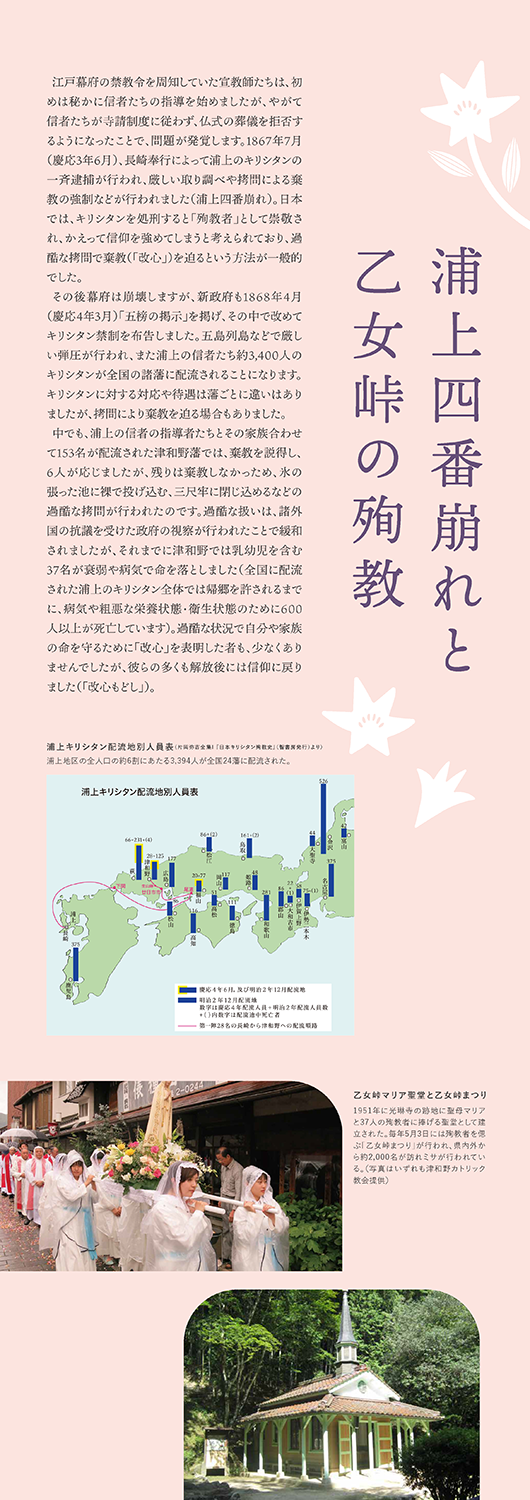
Missionaries who were fully aware of the Edo shogunate’s prohibition of Christianity at first continued their pastoral ministry in secret. However, their presence was eventually revealed when the faithful refused to comply with the terauke (temple registration) system and declined Buddhist funerary rites. In July 1867 (June 1867, in the Keio calendar), the Nagasaki magistrate ordered the mass arrest of the Christians of Urakami. They were subjected to severe interrogations, imprisonment, and torture in an attempt to force them to commit apostasy. This persecution is known as the Fourth Urakami Persecution (Urakami Yonban Kuzure). In Japan, it was believed that executing Christians would lead to their veneration as "martyrs" and would ultimately strengthen the faith. For this reason, the authorities generally sought not execution but enforced "apostasy," using extreme physical and psychological suffering to compel believers to renounce their faith.
Although the shogunate soon fell, the new government in April 1868 (March 1868, in the Keio calendar) issued the Five Public Notices (Gobou no Keiji), once again formally proclaiming the prohibition of Christianity. Severe persecutions followed, particularly in the Goto Islands, and approximately 3,400 Catholics from Urakami were deported and exiled to domains throughout Japan. The treatment of the exiles varied from domain to domain, but often, they were subjected to harsh torture to induce apostasy.
In the Tsuwano Domain, to which 153 persons, including leaders of the Urakami Catholic community and their families, were exiled, officials attempted to persuade the faithful to abandon their faith. Six yielded under pressure, but the others remained steadfast.
As a result, they endured brutal punishments, such as being cast naked into ice-covered ponds and being confined in cramped prison cells known as the Three-Shaku prison cells. These inhumane conditions were gradually alleviated after protests from foreign governments led to official inspections by the authorities. By that time, however, 37 of the exiles in Tsuwano, including infants and young children, had died from illness and exhaustion. (Across Japan, more than 600 Urakami Catholics lost their lives due to disease, malnutrition, and unsanitary conditions before they were finally permitted to return home.) Under these extreme circumstances, many believers professed "apostasy" to preserve their lives or those of their families. Nevertheless, after their release, many of them returned to the Catholic faithful again (kaishin-modoshi).
Table of the Distribution of Exiled Urakami Christians by Domain (From The Complete Works of Kataoka Yayoshi, Vol. I, "The History of Christian Martyrdom in Japan" Chieshobō)
A total of 3,394 people—about 60% of the population of the Urakami district—were exiled to 24 domains across Japan.
Otome Pass Marian Shrine and the Otome Pass Festival
Built in 1951 on the former site of Korin-ji Temple, this shrine is dedicated to the Virgin Mary and 37 martyrs. Each year on May 3, the "Otome Pass Festival" is held in their memory, drawing about 2,000 visitors from within and outside the prefecture for Mass. (All photos courtesy of the Tsuwano Catholic Church.)
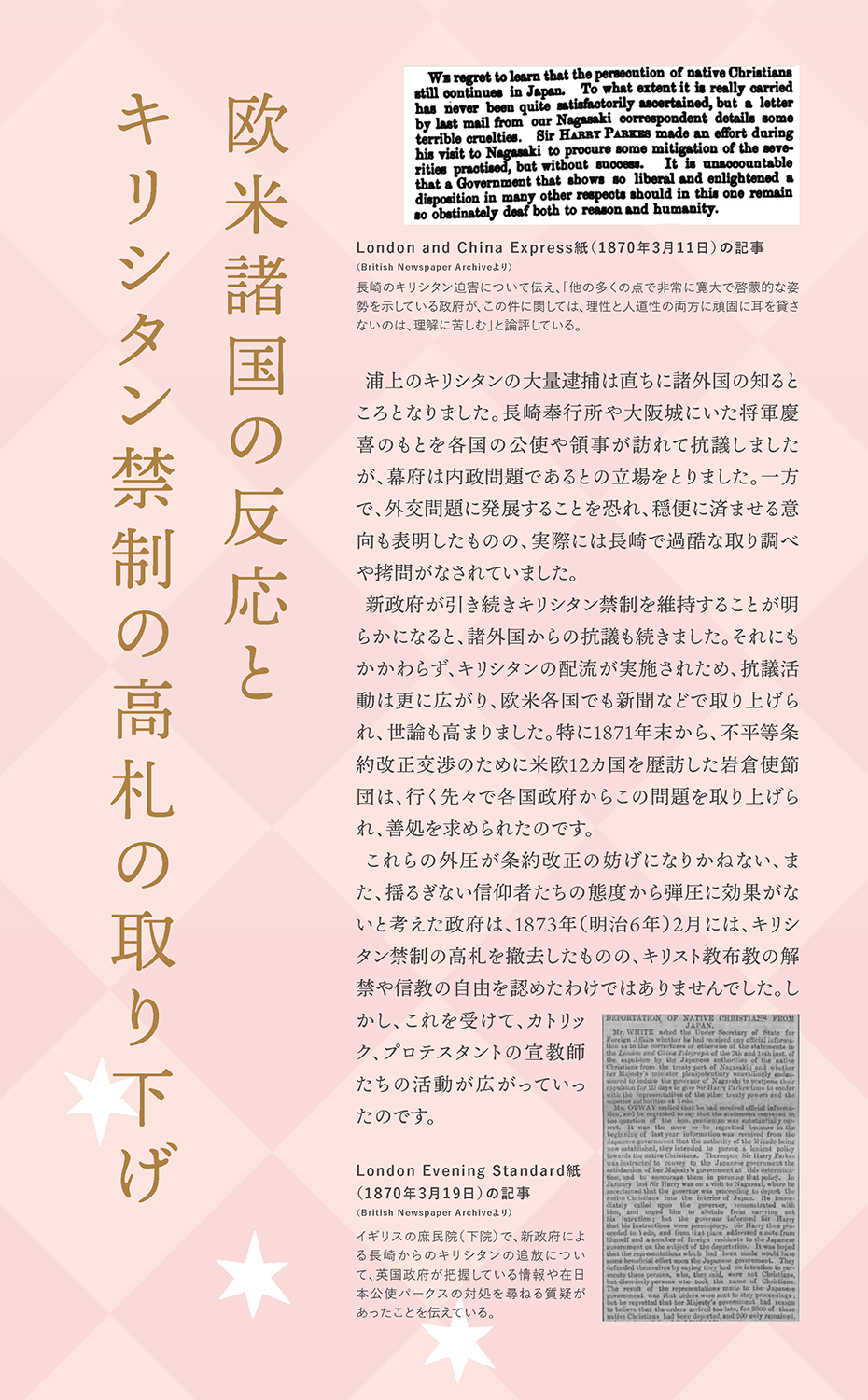
The mass arrests of Christians in Urakami immediately became known to foreign countries. Ministers and consuls from various nations visited the Nagasaki Magistrate's Office and the Shogun Yoshinobu at Osaka Castle to protest; however, the Shogunate maintained that it was a domestic issue. While also expressing an intention to resolve the matter amicably for fear of it developing into a diplomatic problem, in reality, harsh interrogations and torture were being carried out in Nagasaki.
As it became clear that the new government would continue to maintain the ban on Christianity, protests from foreign countries also persisted. Despite this, the exile of Christians was carried out, which further fueled the demonstrations. The issue was reported in newspapers in Europe and in the United States, and public opinion grew. Specifically, the Iwakura Mission, which traveled to 12 countries in the US and Europe starting at the end of 1871 to negotiate the revision of unequal treaties, encountered this issue everywhere they went and were requested to find a solution.
Considering that this foreign pressure could hinder treaty revisions, and realizing that suppression was ineffective due to the unwavering attitude of the faithful, the government abolished the public notice boards (kosatsu) banning Christianity in February 1873 (Meiji 6). However, this did not mean that the propagation of Christianity was permitted or that freedom of religion was granted. Nonetheless, in response to this, the activities of Catholic and Protestant missionaries expanded.
Articles from British Newspapers
London and China Express (March 11, 1870)
Reporting on the persecution of Christians in Nagasaki, the article comments that "it is unaccountable that a government that shows so liberal and enlightened a disposition in many other respects should in this one remain so obstinately deaf both to reason and humanity.”
London Evening Standard (March 19, 1870)
The article reports that questions were raised in the British House of Commons regarding the new Japanese government’s expulsion of Christians from Nagasaki, including inquiries about the information held by the British government and the response of the British minister to Japan, Sir Harry Parkes.
(From the British Newspaper Archive)
Exhibit 1
An Official Notice Board Prohibiting Christianity Issued by the Meiji government
(From the Aoyama Gakuin Museum Collection)
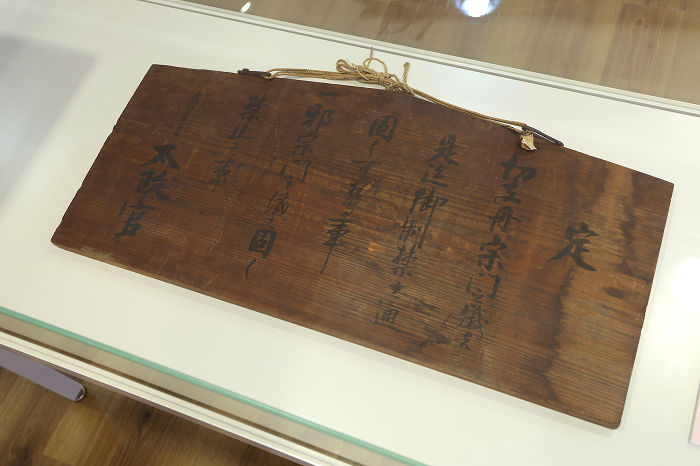
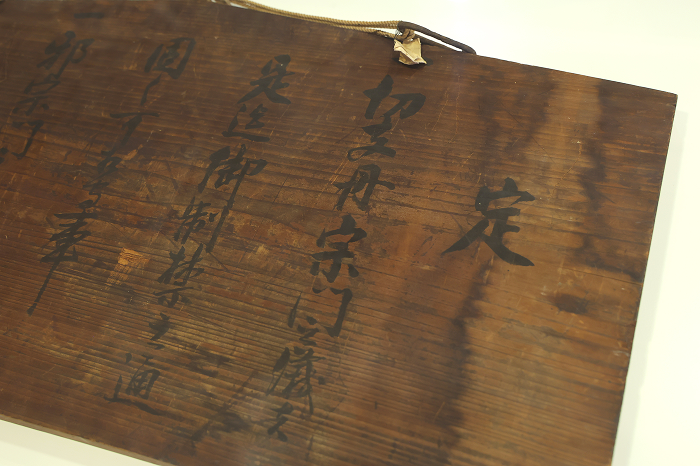
一 Concerning the Christian religion: it has long been strictly prohibited by official decree, and this prohibition must be firmly observed.
一 Concerning evil teachings: they are strictly prohibited.
March, Keio 4 (1868)
Grand Council of State (Dajokan)
During the Edo period, official announcements from the shogunate—such as various prohibitions and the crimes of offenders—were conveyed by writing them on wooden boards and displaying them in conspicuous places. These boards were called "kosatsu" (official notice boards), and the places where they were posted were known as "kosatsu-ba."
The Meiji government initially inherited this practice, and in 1868 (Keio 4/Meiji 1), it erected kosatsu announcing the new government’s directives, known as the “Five Public Notices” (Gobo no Keiji).
The first notice emphasized the observance of moral conduct and strictly prohibited murder, arson, and robbery.
The second prohibited forming gangs, violent appeals, and flight or desertion.
The third prohibited Christianity and evil teachings.
The fourth forbade causing harm to foreigners.
The fifth prohibited abandoning one’s registered status and vagrancy.
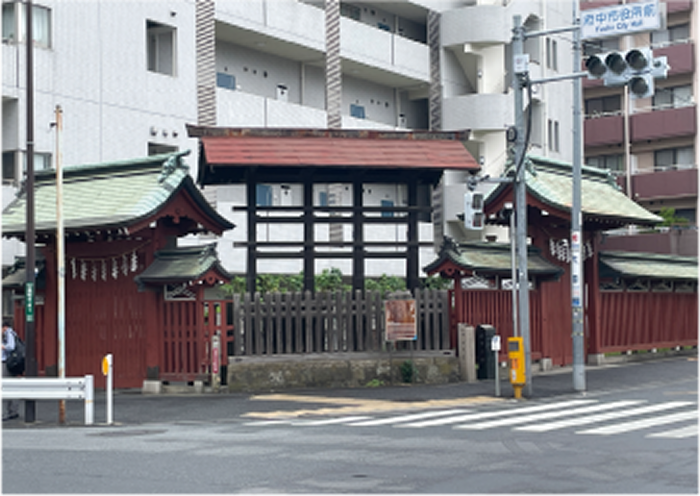
The kosatsu-ba (official notice board site) in Fuchu continues to remain today within the fenced precincts of the Okunitama Shrine Otabisho (photograph by Kazuya Kato). At the time, this location was a key transportation hub where the Koshūu Kaido intersected with the northbound Kawagoe Kaido and the southbound Soshu Kaido (present Fuchu Kaido).
Exhibit 2
Model of the Three-Shaku Prison Cell
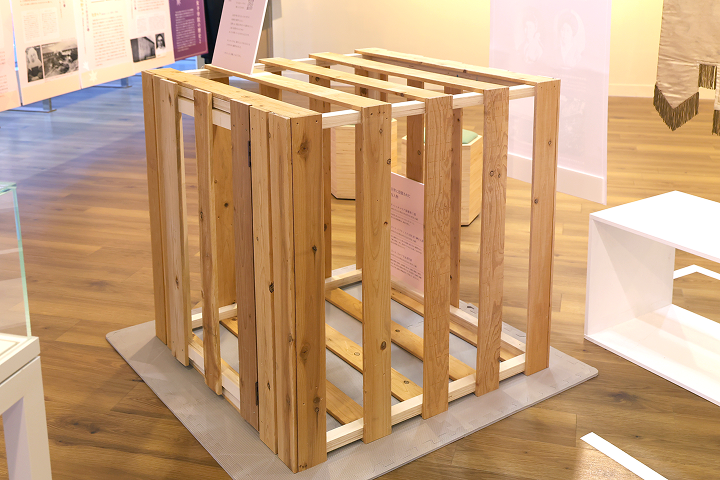
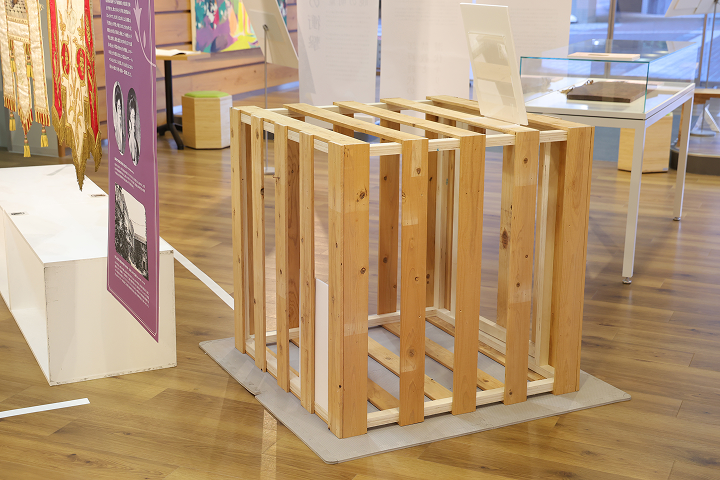
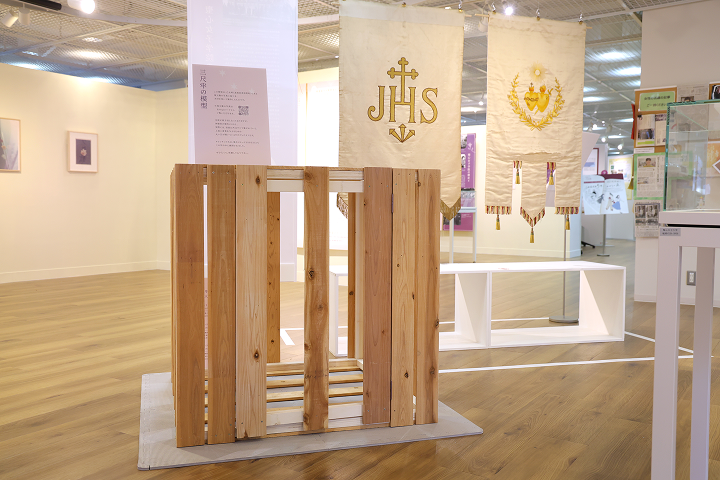
This model has been constructed from wood based on photographs of a reconstructed structure located at Otome Pass (Tsuwano, Shimane Prefecture).
Although this model is latticed on all sides, reports from those who have experienced it indicate that, in reality, all sides except the front were sealed, with only a small circular opening at the top through which food was provided.
Christians were, in some cases, confined within this prison for more than ten days.
※ Images of the reconstructed structure can be viewed at the URL below.
https://www.shimane19.net/report/tsuwano/633
Main Figures Imprisoned in the Three-Shaku Prison Cell
1. Antonio Maria Fukahori Wasaburo
(Died: November 22, 1868 [October 9, Meiji 1], aged 26)
The first person to die. One of the leaders of the Urakami Christians, he was confined in a three-shaku prison cell for 20 days and died of illness.
2. John the Baptist Sakaki Yasutaro
(Died March 4, 1869 [January 22, Meiji 2], aged 30)
He was confined in a three-shaku prison cell and, at times, forced to sit on the frozen ground in the snow while being pressured to renounce his faith. He became debilitated with severe diarrhea and died. It is said that he told his fellow prisoners that a beautiful woman like the Virgin Mary appeared to him every night.
3. John Joseph Iwanaga Seishiro
(Died March 30, 1869 [February 18, Meiji 2], aged 53)
He was weakened by torture after his arrest, sent to Tsuwano, contracted dysentery, and died of illness. His daughter, Tsuru, was exiled to Hagi and subjected to torture but survived, returned to Nagasaki, and later became a member of the Jujikai (Society of the Cross), the first Japanese lay religious association.