
Chapter Three
The Fruits of Catholic Education
— Light illuminating the world
※ Click on the image to view a larger version. PDF File
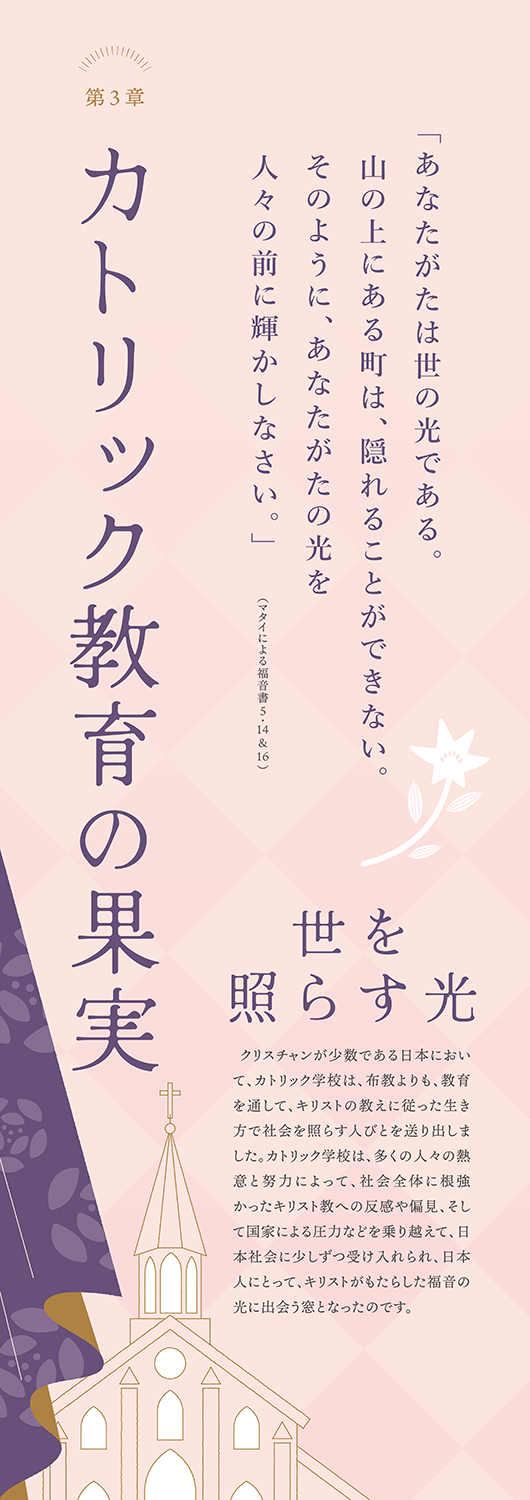
In Japan, where Christians are a minority, Catholic schools chose not so much to focus on direct evangelization as to form people who would illuminate society by living in accordance with Christ’s teachings through education. Through the passion and dedication of many individuals, Catholic schools overcame deep-rooted social resistance and prejudice toward Christianity, as well as pressure from the state. Gradually, they came to be accepted within Japanese society and became, for many Japanese people, a window through which they could encounter the light of the Gospel brought by Christ.
“You are the light of the world. A town built on a hill cannot be hidden.
In the same way, let your light shine before others, that they may see your good deeds and glorify your Father in heaven.” (Matthew 5: 14&16)
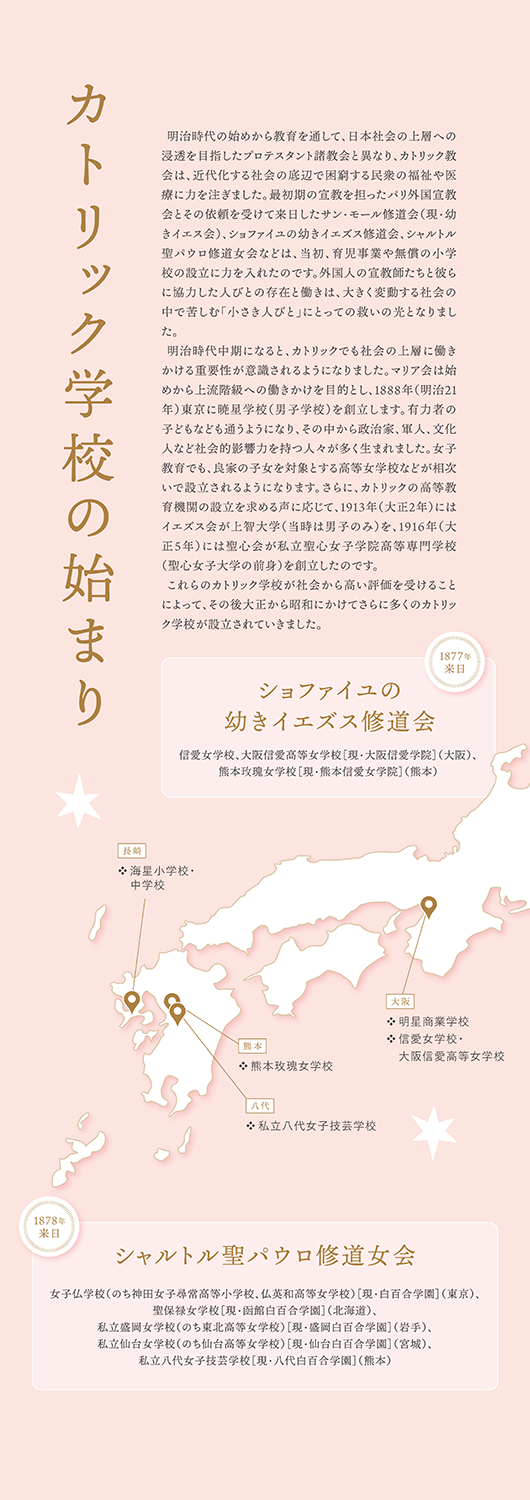
In contrast to the Protestant churches, which from the beginning of the Meiji period sought to penetrate the upper strata of Japanese society through education, the Catholic Church devoted its energies to the welfare and medical care of the impoverished people at the base of a rapidly modernizing society. The Paris Foreign Missions Society, which played a central role in the earliest phase of Catholic evangelization, together with the religious congregations that came to Japan at its request—such as the Sisters of Saint-Maur (now Infant Jesus Sisters), the Sisters of the Infant of Chauffailles, and the Congregation of the Sisters of Saint Paul of Chartres—initially focused their efforts on childcare initiatives and the establishment of tuition-free elementary schools. The presence and work of foreign missionaries and those who cooperated with them became a light of salvation for the “little ones” who suffered amid the profound social upheavals of the time.
By the mid-Meiji period, however, Catholics also came to recognize the importance of engaging with the upper levels of society. From the outset, the Society of Mary's Fathers aimed their educational mission at the elite, and in 1888 (Meiji 21), they founded Gyosei School, a boys’ school, in Tokyo. Children of influential families began to attend, and from among its graduates emerged many individuals who would wield significant social influence, including politicians, military officers, and cultural leaders. Similarly, the Society of Mary's Fathers established a series of higher girls' schools aimed at the daughters of well-to-do families in the field of girls' education.
Furthermore, in response to growing calls for Catholic institutions of higher education, the Jesuits founded Sophia University in 1913 (Taishō 2), then for men only, and in 1916 (Taishō 5), the Society of the Sacred Heart established Sacred Heart Senmon Gakko (Women’s Higher School of Professional Studies), the predecessor of the present-day University of the Sacred Heart. As these Catholic schools came to be highly regarded by society, many more Catholic educational institutions were subsequently established from the Taishō through the Shōwa periods.
Sisters of the Infant Jesus of Chauffailles (arrived in Japan in 1877):
Shinai Girls’ School; Osaka Shinai Girls’ High School [now Osaka Shinai Jogakuin] (Osaka); Kumamoto Maikai Girls’ School [now Kumamoto Shinai Jogakuin] (Kumamoto).
Congregation of the Sisters of St. Paul of Chartres (arrived in Japan in 1878):
Joshi Futsu Gakko (Girls’ French School; later Kanda Girls’ Elementary and Higher Elementary School, and Futsu-Eiwa Girls’ High School) [now Shirayuri Gakuen] (Tokyo); St. Paul’s Girls’ School [now Hakodate Shirayuri Gakuen] (Hokkaido); Morioka Private Girls’ School (later Tohoku Girls’ High School) [now Morioka Shirayuri Gakuen] (Iwate); Sendai Private Girls’ School (later Sendai Girls’ High School) [now Sendai Shirayuri Gakuen] (Miyagi); Yatsushiro Private Girls’ School of Arts and Crafts [now Yatsushiro Shirayuri Gakuen] (Kumamoto).
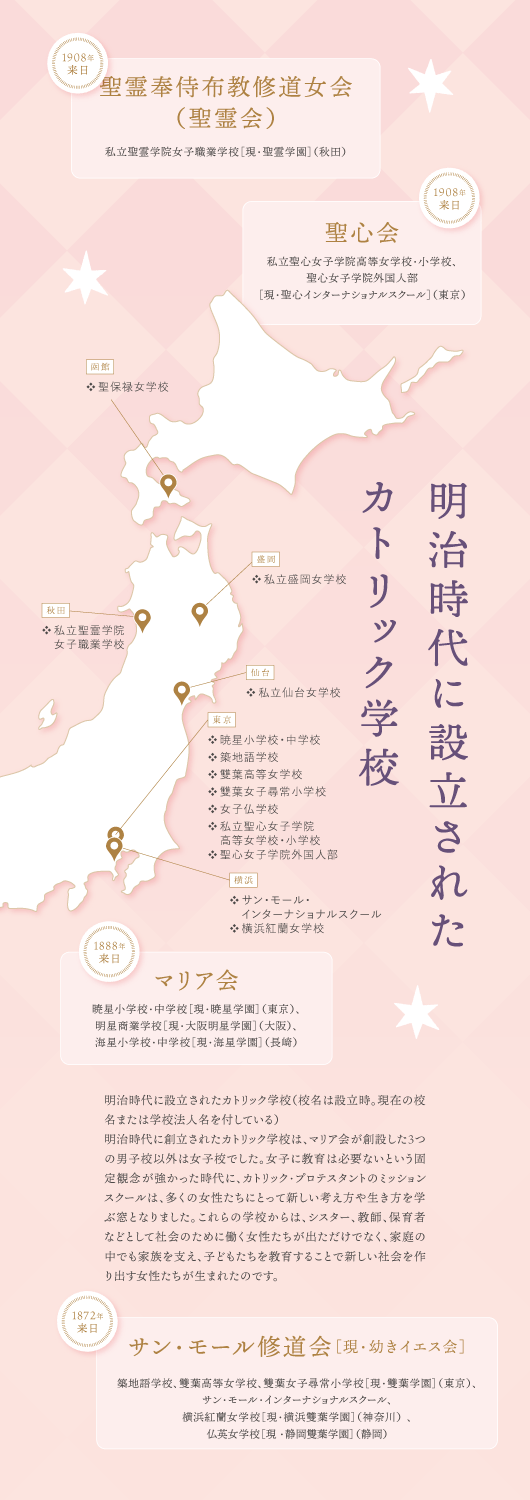
Catholic Schools Established in the Meiji Period
(The names of the schools are those from the time of their founding; the current names of the schools or educational corporations appear in brackets.)
Except for the three boys’ schools founded by the Society of Mary (Marianists), Catholic schools established during the Meiji period were girls’ schools. At a time when the belief that education for girls was unnecessary was deeply entrenched, Catholic and Protestant mission schools became windows through which many women encountered new ways of thinking and living. From these schools emerged not only women who worked for society as sisters, teachers, and childcare workers, but also women who supported their families at home and educated their children, thereby helping to create a new society.
Missionary Sisters Servants of the Holy Spirit (Holy Spirit Sisters) (arrived in Japan in 1908):
Private Seirei Gakuin Girls’ Vocational School [now Seirei Gakuen] (Akita).
Society of the Sacred Heart (arrived in Japan in 1908):
Sacred Heart High School and Elementary School; Sacred Heart School Gogakko (for Foreigners ) [now Sacred Heart International School] (Tokyo).
Society of Mary (arrived in Japan in 1888):
Gyosei Elementary and Junior High School [now Gyosei Gakuen] (Tokyo); Meisei Commercial School [now Osaka Meisei Junior & Senior High School] (Osaka); Kaisei Elementary and Junior High School [now Kaisei Gakuen] (Nagasaki).
Sisters of St. Maur (now the Infant Jesus Sisters) (arrived in Japan in 1872):
Tsukiji Language School; Futaba Girls’ High School; Futaba Girls’ Elementary School [now Futaba Gakuen] (Tokyo); St. Maur International School; and Yokohama Kōran Girls’ School [now Yokohama Futaba Gakuen] (Kanagawa).
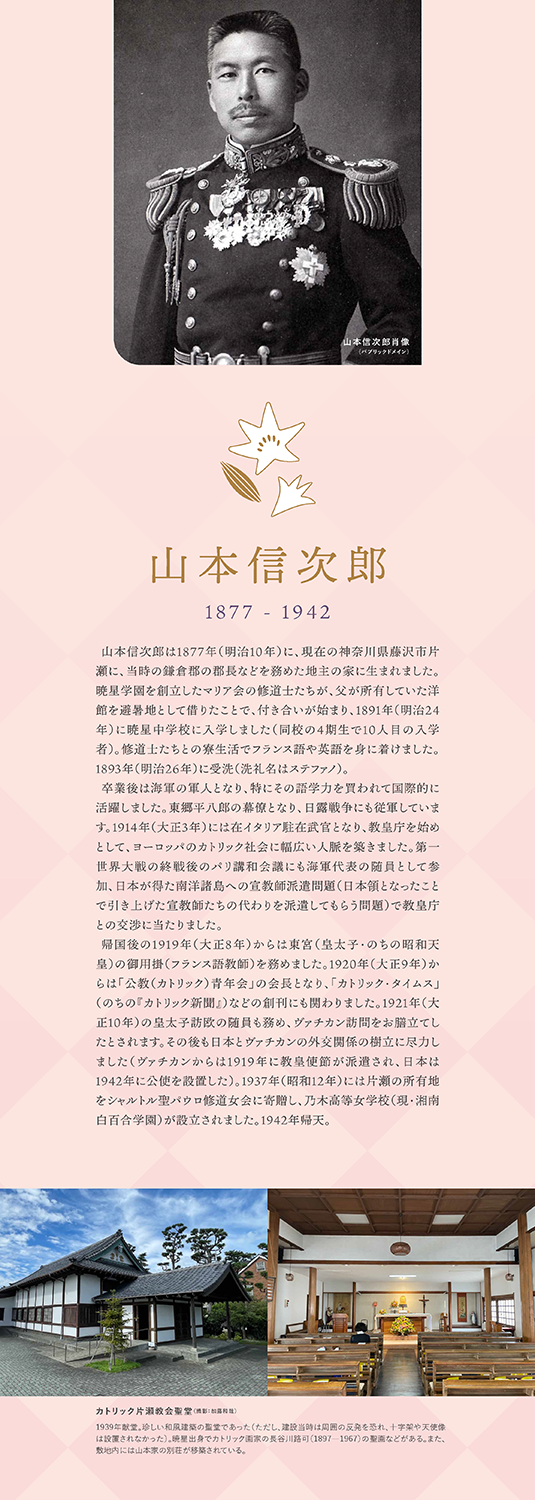
Shinjiro Yamamoto was born in 1877 (Meiji 10) in Katase, present-day Fujisawa City in Kanagawa Prefecture, into a landowning family whose head had served, among other posts, as the district chief of Kamakura District. His association with the Marianist Brothers, who later founded Gyosei School, began when they rented a Western-style house owned by his father as a summer retreat. In 1891 (Meiji 24), Yamamoto entered Gyosei Junior High School as a student of its fourth class and the tenth enrollee overall. Through boarding life with the brothers, he acquired proficiency in French and English. He was baptized in 1893 (Meiji 26), taking the baptismal name Stephen.
After graduation, he pursued a career in the Imperial Japanese Navy, where his linguistic abilities were highly valued and enabled him to work extensively on the international stage. He served on the staff of Heihachiro Tōgō and took part in the Russo-Japanese War. In 1914 (Taishō 3), he was appointed naval attaché to Italy, during which time he built an extensive network within Catholic circles across Europe, including the Holy See. He also attended the Paris Peace Conference following the end of World War I as a member of the Japanese naval delegation, where he was involved in negotiations with the Vatican concerning the dispatch of missionaries to the South Seas Islands—territories that had come under Japanese control and from which missionaries had previously withdrawn.
From 1919 (Taishō 8), after returning to Japan, Yamamoto served as an aide to the Crown Prince (later Emperor Shōwa), acting as his French-language instructor. Beginning in 1920 (Taishō 9), he served as president of "the Catholic Youth Association" and was involved in the founding of "The Catholic Times" (later "The Catholic Shimbun"). He also accompanied the Crown Prince on his tour of Europe in 1921 (Taishō 10) and is said to have helped arrange the prince’s visit to the Vatican. Thereafter, he continued to devote himself to the establishment of diplomatic relations between Japan and the Vatican. A papal representative was dispatched to Japan in 1919, and Japan later established a legation to the Vatican in 1942.
In 1937 (Showa 12), Yamamoto donated his property in Katase to the Congregation of the Sisters of Chartres, leading to the establishment of Nogi Higher Girls’ School, now known as Shonan Shirayuri Gakuen. He passed away in 1942.
Portrait of Shinjiro Yamamoto (public domain).
Katase Catholic Church (photograph by Kazuya Kato).
Consecrated in 1939, this was an unusual church built in a traditional Japanese architectural style. At the time of its construction, however, crosses and angel statues were not installed out of fear of local opposition. The church houses sacred artworks by Michika Hasegawa (1897–1967), a Catholic painter and alumnus of Gyosei School. A former villa of the Yamamoto family has also been relocated to the church grounds.
Exhibit 5
Banners of the “Sacred Heart”
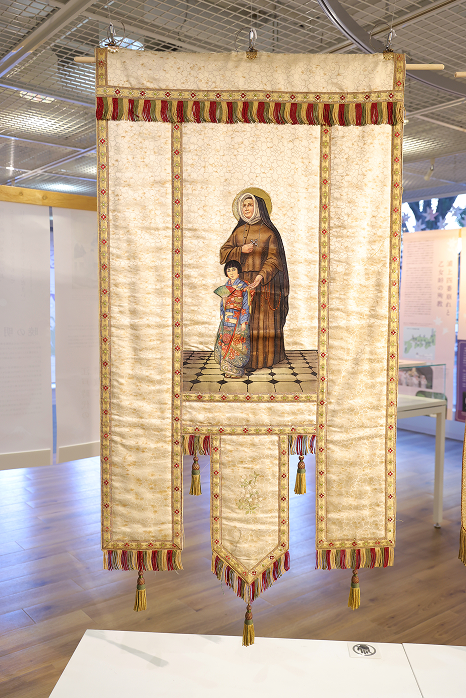
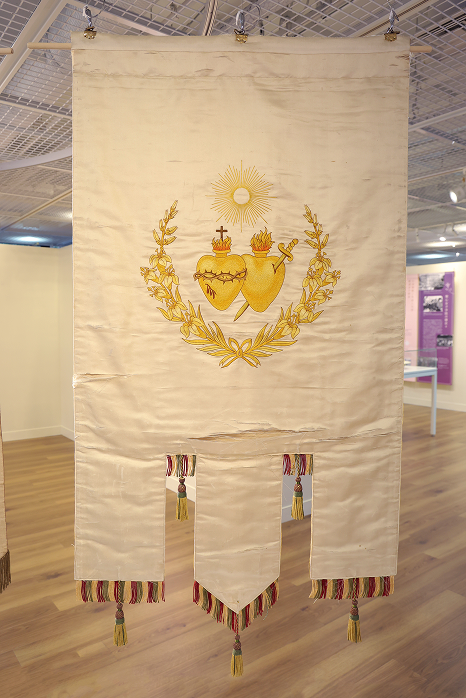
Banner titled “Saint Madeleine Sophie Barat and the Children of Japan.(Left:表面 / Right:裏面)
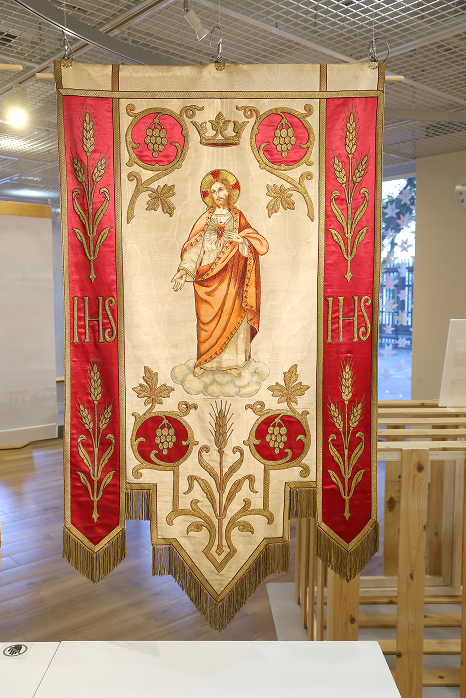
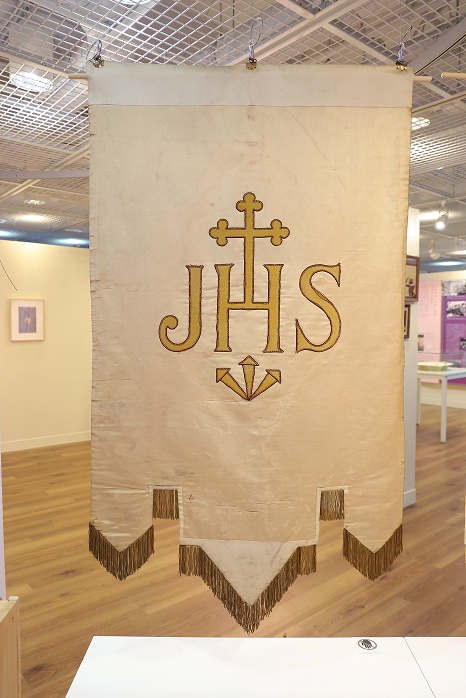
Banner of the Sacred Heart (Mikokoro).(Left:表面 / Right:裏面)
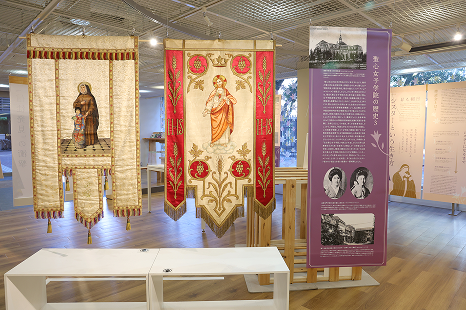
These banners were used in processions held on feast days and other celebratory occasions.
At the Sacred Heart School, the first Eucharistic procession—honoring "the Blessed Sacrament" —was held on June 27, 1919 (Taishō 8), the Feast of the Sacred Heart. This was the first Eucharistic procession ever held at a Catholic school in Japan. Thereafter, processions were conducted on various celebratory occasions.
At the University of the Sacred Heart as well, a “Torchlight procession,” in which participants carried lit torches, was once held as part of the graduation ceremony. Although the procession itself is no longer practiced, the name continues to be preserved in the events of graduation week.
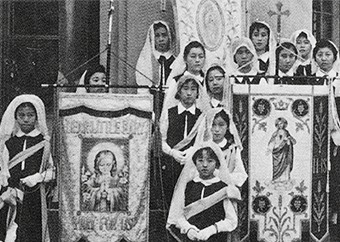
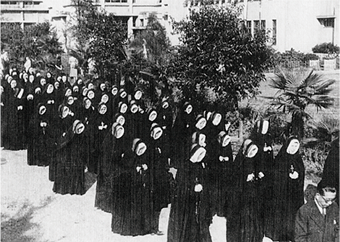
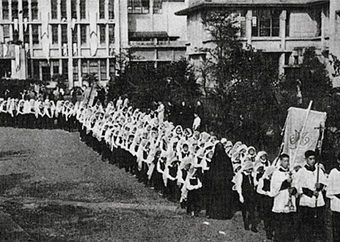
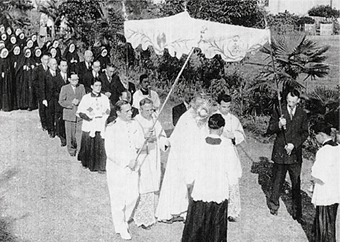
The Eucharistic Procession as it was conducted at the Sacred Heart School (after World War II)(from Mikokoro Kai Newsletter, No. 70)
Exhibit 6
On the Sacred Painting "Our Lady, Morning Star"
(Collection of Katase Catholic Church)
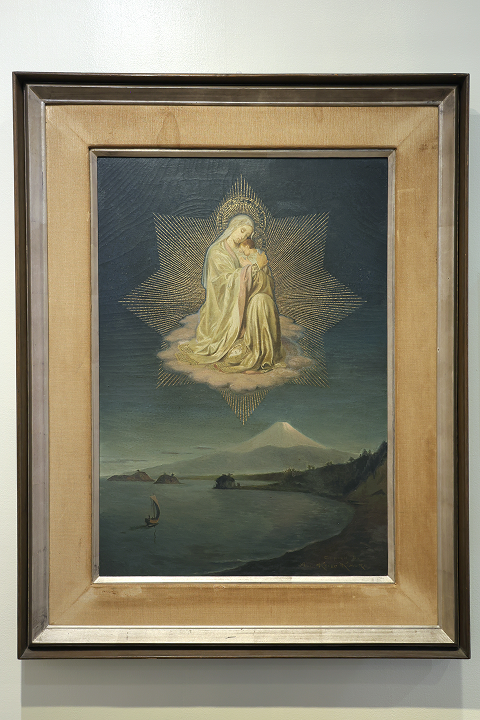
Sacred Painting: Our Lady, Morning Star
(A copy by the Catholic painter Keizō Kimura)
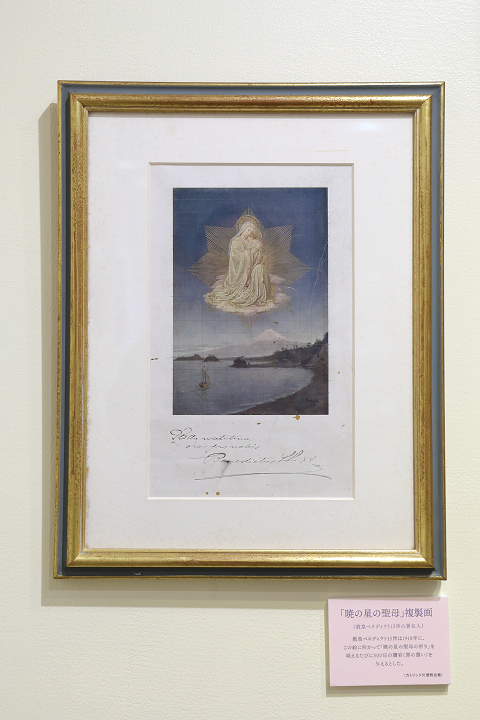
Reproduction of "Our Lady, Morning Star"
(Bearing the signature of Pope Benedict XV)
In 1918, Pope Benedict XV granted an indulgence of 300 days each time "the Prayer to Our Lady, Morning Star" was recited before this image.
On the Sacred Painting "Our Lady, Morning Star" (exhibited Item)
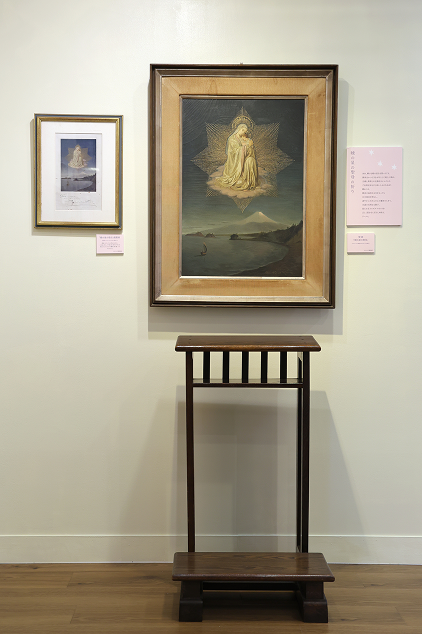
Among the schools founded by the Marianist Fathers are Gyosei (Tokyo), Kaisei (Nagasaki), and Meisei (Osaka). All of these school names derive from titles of the Blessed Virgin Mary. As their name suggests, the Marianist Fathers are a religious congregation that venerates the Virgin Mary as the model of a person who faithfully followed Christ.
This painting was commissioned in 1917, when Shinjiro Yamamoto was serving as a naval attaché in Italy, and was executed by the Italian woman painter Luisa Mussini (1865–1925). Based on this image, reproductions and prayer cards were produced and circulated—primarily in France—to promote the spread of Christianity in Japan. These were accompanied by "The Prayer to Our Lady, Morning Star," composed by Ernest Morris, principal of the Marianist College in Rome. Later, Soichi Iwashita, a younger alumnus of Gyosei School, carried on this initiative during his stay in Europe from 1919 on. He produced cards in five languages and distributed them worldwide. Through this image, people around the world prayed for the growth of Christianity in Japan.
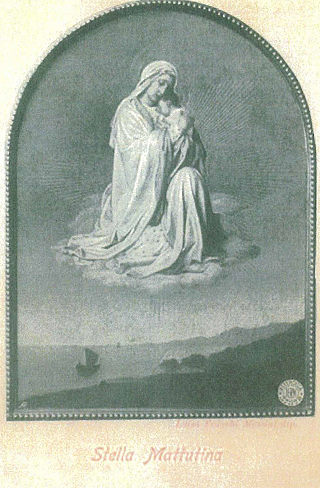
Figure 1. Luisa Mussini, Our Lady, Morning Star (before 1905; collection of Victoria University, Australia).
A work by Mussini closely resembling this painting, also titled "Our Lady, Morning Star" (Fig. 1), is known. In that original version, the landscape spread beneath the Madonna and Child has been replaced in the present work with a scene centered on Mount Fuji. The depiction of Mount Fuji has been identified—based on the shapes of the bay and nearby islands in the foreground—as the view from Shishigahama in Numazu (Fig. 2). Moreover, because the motif closely resembles "Sailing Boats off West Izu" by the Japanese painter Ohara Koson (Fig. 3), it is presumed that Mussini may have referred to that work when composing this painting.
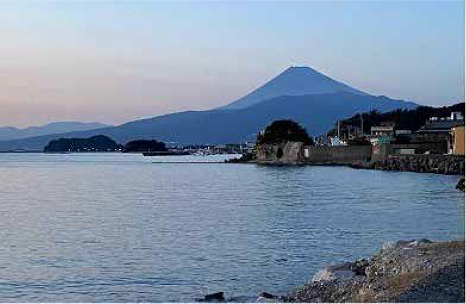
Figure 2. Mount Fuji as seen from Shishigahama Beach (photograph by a private individual).
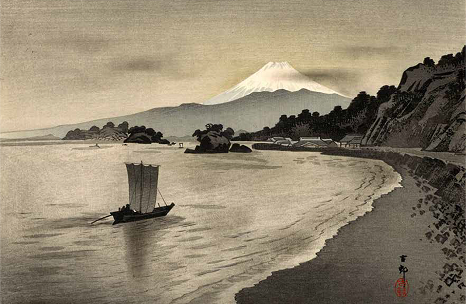
Figure 3. Ohara Koson, Sailing Boats off the West Coast of Izu (1900), public domain.
Prayer to Our Lady, Morning Star
who in thy very appearance upon earth didst signify the speedy rising of the Sun of Justice and of Truth; shine sweetly upon the people of Japan, so that, shaking off the darkness of their minds, they may faithfully acknowledge the brightness of Eternal Light, Thy Son Our Lord Jesus Christ.
Amen.