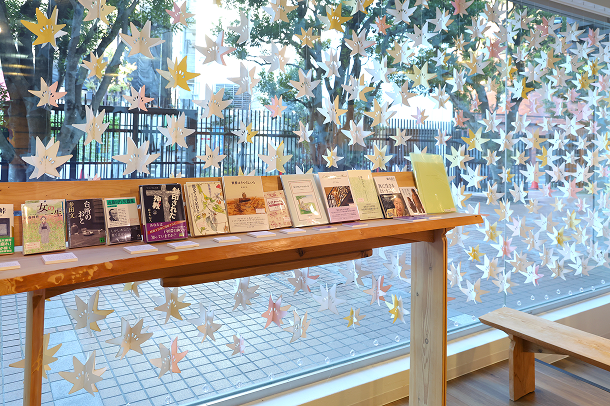
Related Exhibitions
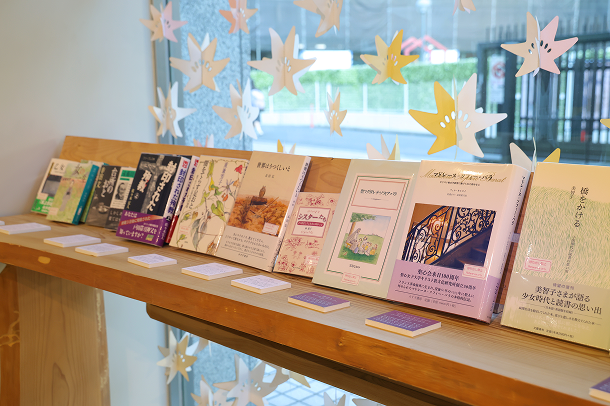
Recommended reading list
for the exhibition
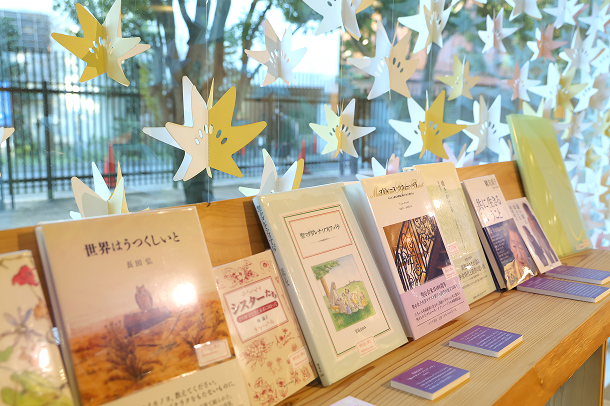
"The World Is Beautiful" may be described, if one may put it this way, as a poetry collection for moments of repose. Repose is both a form of experimental calm and a source of “ethical power.” As Roland Barthes writes, “To rest is to willingly relinquish all forms of heroism” (from the author’s afterword). The title poem, “The World Is Beautiful,” serves as the basso continuo of this exhibition project.
"A Woman’s Life, Part II": Sachiko’s Story
These two works were written by Shusaku Endo (1923–1996), one of Japan’s most prominent Catholic authors.
Part I: Kiku’s Story is set against the historical background of the persecution of Christians in Nagasaki from the late Edo period to the Meiji era. It portrays the brief yet pure life of Kiku, a young woman who harbors deep feelings for a Christian youth.
Part II: Sachiko’s Story depicts the harsh fate of Sachiko and Shuhei, who meet and fall in love in wartime Nagasaki during World War II. Shuhei, tormented by the conflict between the teachings of the Bible and his duties as a soldier, ultimately departs as a kamikaze pilot, while Nagasaki, where Sachiko lives, is struck by the atomic bomb.
“Fudanotsuji” is a short story by the Catholic writer Shusaku Endo. A graduate of a Catholic university, on his way to a class reunion, recalls visiting Fudanotsuji—a site where Christians were executed during the Edo period—together with a monk nicknamed “Mouse” during his student days. At the reunion, he learns about the subsequent course of “Mouse’s” life.
(The monk is modeled on Father Maximilian Kolbe, who offered his life in place of a fellow prisoner at Auschwitz and died by starvation.)
This work chronicles the historical events of the Urakami Christians, who were exiled to Tsuwano and from whom many martyrs emerged. It was written by Takashi Nagai (1908–1951), a Catholic physician who himself survived the atomic bombing of Nagasaki and devoted his life to the treatment of atomic bomb victims.
Nagai completed this work shortly before his death from leukemia caused by radiation exposure.
This two-volume work is a work of reportage that traces the life of a Catholic priest who served as diocesan administrator in Sapporo and Yokohama before the war; endured persecution—including arrest for his outspoken opposition to the war; and met a mysterious death shortly after the end of World War II. The book also investigates the truth behind the incidents surrounding his death. (The author, Hiroto Sasaki, is a Catholic lay believer and a former reporter for the Mainichi Shimbun, who completed this work while battling a serious illness.)
This work tells the story of Soichi Iwashita and the patients of Kamiyama Rehabilitation Hospital, based on interviews and field research conducted with patients. It was written by Yoshiko Shigekane (1927–1993), an Akutagawa Prize–winning author and a Protestant believer.
This book offers a clear and accessible overview of the history of religious life, the way of life of Catholic sisters, the process of becoming a sister, and the diverse ministries in which sisters are engaged around the world today. The author is a sister of the Society of the Helpers of the Holy Souls.
This illustrated biography of Saint Madeleine-Sophie Barat was written by picture-book author Naomi Kojima, known for works such as The Flying Grandmother and The Singing Shijimi Clam. The author is an alumna of the Sacred Heart School.
translated by Mami Adachi and Mayumi Tomihara, Misuzu Shobo
Drawing on an extensive body of correspondence and historical documents, this scholarly biography portrays the life of Saint Madeleine-Sophie Barat, founder of the Society of the Sacred Heart, and the history of the Society itself. The author is a Sister of the Society of the Sacred Heart and a historian. The translators are Mami Adachi, president of the University of the Sacred Heart, and Mayumi Tomihara, Professor Emeritus of the University of the Sacred Heart.
This book is a record of a lecture in which Her Majesty Empress Emerita Michiko reflects on how books gave her a sense of inner grounding and courage during the war and expresses her hope that, through reading, children may find hope and peace.
Her Majesty was educated at Catholic schools from elementary school through university: Futaba Elementary School; the Elementary School attached to Nogi Girls’ High School (now Shonan Shirayuri Gakuen Elementary School); Sacred Heart School (Junior and Senior High School); and the University of the Sacred Heart. She is a graduate of the Department of Foreign Languages and Literature (now the Department of English Language, Culture, and Communication), class of the 7th cohort.
Sadako Ogata was born in 1927. Her maiden name was Sadako Nakamura. After spending her early childhood in the United States, she returned to Japan in the fifth grade and transferred to the Sacred Heart School. She went on to attend the girls’ high school and later graduated from the Department of Foreign Languages and Literature (now the Department of English Language, Culture, and Communication) at the University of the Sacred Heart as a member of its first graduating class.
Encouraged by her father and by Elizabeth Britt, president of the University of the Sacred Heart, she pursued graduate studies at Georgetown University and the University of California, Berkeley, where she earned a doctorate in political science. During this period, she returned to Japan, married, and, after completing her doctorate, worked as a part-time university lecturer. At the invitation of Fusae Ichikawa, she joined the Japanese delegation to the United Nations, becoming Japan’s first female minister to the UN in 1976. She later served as the Japanese government representative to the UN Commission on Human Rights.
From 1991 to 2000, she served as the eighth United Nations High Commissioner for Refugees. From 2003 to 2012, she was president of the Japan International Cooperation Agency (JICA). She passed away in 2019.
Atsuko Suga was born in 1929. After transferring from Kobayashi Sacred Heart School for Girls to the Sacred Heart School for Girls in Tokyo, she returned to Kobayashi during the war and graduated there. After the war, she entered the University of the Sacred Heart and graduated from the Department of Foreign Languages and Literature (now the Department of English Language, Culture, and Communication) as a member of its first graduating class.
This essay collection reflects on her experiences with reading from childhood through her university years. After graduating from university, Suga spent her late twenties through the end of her thirties in Italy, where she married an Italian. Following her husband’s death, she returned to Japan and, while serving as a part-time lecturer at institutions including Sophia University, became known as a translator of Italian literature and as an essayist. She passed away in 1998.